Summary of the Events of 30 Oct 1917
The 2nd/8th Battalion, London Regiment (Post Office Rifles), was heavily engaged on October 30, 1917, during the Second Battle of Passchendaele, part of the larger Third Battle of Ypres in World War I. This Territorial Force battalion, formed in September 1914 and composed largely of former postal workers, had landed in France in 1917 as part of the 58th (2/1st London) Division, specifically within the 174th Brigade.
On that date, the 2nd/8th Battalion participated in an attack near Poelcappelle in the Ypres Salient, a notoriously muddy and heavily contested area. The Second Battle of Passchendaele aimed to capture the Passchendaele Ridge, but the conditions were atrocious—torrential rain had turned the battlefield into a quagmire, making movement and communication extremely difficult. The battalion’s objective was to advance through this terrain under intense German artillery and machine-gun fire.
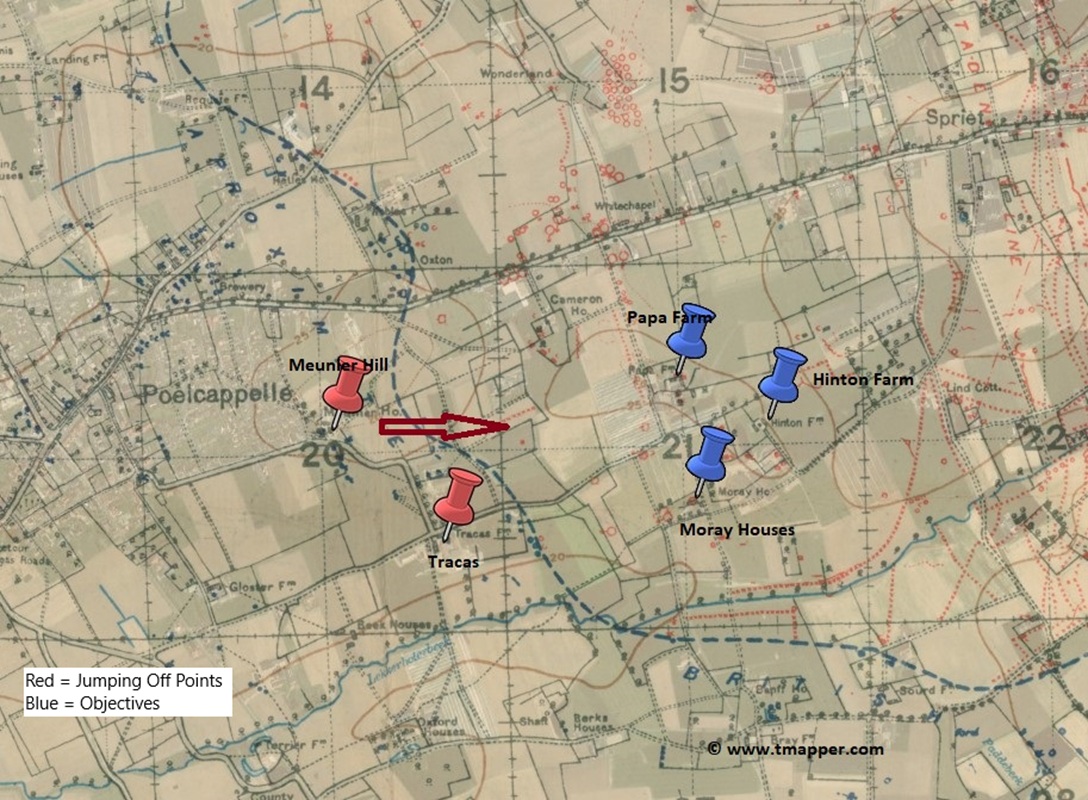 Click to Enlarge
The attack on October 30 was part of a broader offensive by the 58th Division. The 2nd/8th Battalion suffered catastrophic losses: over 200 men were killed or died of wounds shortly afterward, with many more wounded or missing. Historical accounts note that 101 of these soldiers are commemorated on the Tyne Cot Memorial, indicating they have no known grave—a testament to the chaos and destruction of the battle. The battalion’s war diary and survivor accounts describe the assault as a desperate struggle, with men bogged down in mud, unable to advance effectively, and exposed to relentless enemy fire. Many resorted to crawling on all fours but quickly became exhausted. Few men got close to the targets and the battalion suffered 248 casualties before retiring to the starting points. This engagement was one of the battalion’s most devastating moments.
By early 1918, due to such heavy casualties and manpower shortages, the 2nd/8th Battalion was absorbed into the 1/8th Battalion, effectively ending its independent existence. The losses on October 30, 1917, reflect the brutal reality of the Passchendaele campaign, where gains were minimal and the human cost was staggering.
Obituary from Leamington Spa Courier - 9 November 1917
Leamington Spa Courier - November 1917
CAPT F. PERCY WHEELDON (KILLED)
Deep regret has been occasioned by the news that Capt. F. Percy Wheeldon, of the London Regt., was killed in action on the 30th ult. The third son of Mr. and Mrs. Wheeldon of “Hillside,” Leamington, Capt. Wheeldon was deservedly esteemed and, by his charming disposition and splendid character, made himself beloved by all who knew him. He was 32 years of age, and, in addition to his well-known brilliant characteristics, won deserved admiration by his many good qualities. He joined the St Paul’s choir when eight years of age, and at the age of 15 earns became articled to the then organist, Mr. A. E. Gibbs. Mus.B. Capt. Wheeldon made rapid strides in his profession, and ultimately took the diploma of Fellow of the Royal College of Organists. Six years later he removed to Wells, and was soon appointed sub-organist of Wells Cathedral.
Subsequently he became organist of Wrington Parish Church, where he was also very successful as conductor of the Wrington Choral Society. In July 1914 he received an important position as organist at the Parish Church at Weston-super-Mare.
The war having broken out, he joined the R.A.M.C., and afterwards was transferred to the London Regt. (Post Office Rifles), in which he received his commission in 1915. In 1916 he was gazetted Captain, and afterwards proceeded to France. Capt. Wheeldon was seriously wounded at Bellecourt [Bullecourt] last May and was sent to Wandsworth Hospital. As soon as he was sufficiently recovered he went again to join his regiment. Immediately before doing so he took the musical part of the services at Lillington Parish Church [in Warwickshire], and in the evening gave a fine organ recital. On the day before his embarkation he played the Choral Communion Service at Lillington – for the harvest festival – leaving for France the same evening (October 8th). Capt. Wheeldon’s death is greatly lamented, as he was much esteemed both for his personal character and his great skill as an organist.
Mr. and Mrs. Wheeldon still have three sons serving in H.M. Forces. One of them, Private John Wheeldon, a despatch rider, saw the deceased just before he went into action. In a wallet found on Capt. Wheeldon’s body was a letter sealed up ready for posting to his parents. In this he wrote: “This is the eve of battle. The Battalion goes into the line tonight, and we attack at dawn. I am going in command of ‘A’ Company, and our job is a difficult one, but I go in quite cheerfully, trusting I may do my duty well myself and by the men. Plucky fellows they are! I am in a hut with about 20 of them now, and it might be just an ordinary occasion, so cheerful they are. Well, dearest Dad and Mother, I can only trust that I may come through safely; it rests in God’s hands, and whatever happens you will try to look on it as His will, won’t you?”
The commanding officer of the regiment, writing to the bereaved father, says: “Your son fell at the head of his Company in an attack on the enemy position, shot by machine gun through the brain, and his C.S.M. was killed by his side. It is some poor consolation to know that his death was instantaneous, that he felt and knew nothing, but just fell and died the glorious death of a soldier fighting for his country and for those dear to him. I only knew him for some three weeks, but had learned to like and appreciate him in that time and to know what a gallant fellow he was; he was eager to be in this fight, smiling and cheerful up to the last moment I saw him, and it speaks much for an officer that he was universally loved by all who knew him.
Now, I know how you and his mother will fell that nothing can offer real consolation; in this moment I would ask you to remember the thousands, almost millions, of parents mourning the deaths of their soldier sons, and with them to share their grief and mutual sympathy and with them to be proud that they and you have given a dear son for the country; the sacrifice will not be in vain, and that is the part of this war of those who have to wait and suffer. It is a bitter part, but no less great than that of us who bear the brunt of the actual fighting, and it is being bravely borne by thousands.”
The Adjutant of the Regiment has also sent a letter of sympathy, in the course of which he says. “I am personally very upset about ‘Jimmie,’ as we called him. I have been with him in the Battalion since July 1915, and we were all very fond of him.”


