
South Warwickshire Family History Society War Memorial Transcription Project
The Fallen Men of South Warwickshire - World War One |
||
|
|

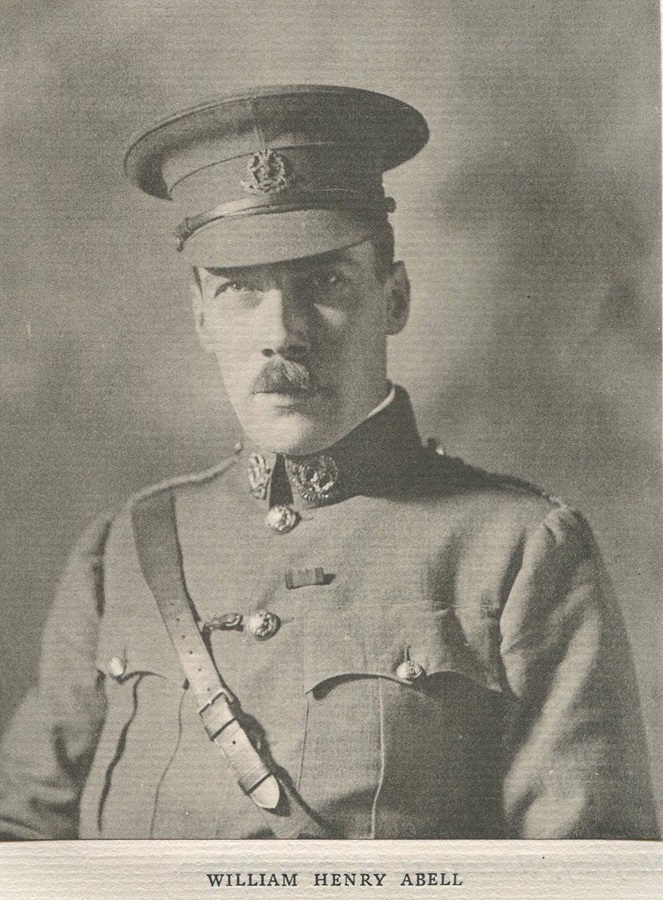

|
Military History |
| Theatre of War | Medals | Commonwealth War Grave or Memorial |
|---|---|---|
| France and Flanders | 1914 Star & Clasp, British War & Victory Medals | St. Symphorien Military Cemetery |
| Arrived in Theatre | Other Campaign Medals | SWFHS Area Memorials |
| 14 Aug 1914 in Boulogne | Queens South Africa Medal | New Milverton |
| Action, Battle or Other Reason Killed | Date and Place Enlisted | Other War Memorials |
| Battle of Mons | Commissioned 9 Dec 1896 | Little Comberton |
| Place of Death | Previous Regiments or Units | |
| Obourg, Mons | ||
Military Service History
- 09 Dec 1896 - Commissioned as 2nd Lt in Middlesex Regiment
- 09 Oct 1899 - Promoted to Lieutenant
- 15 Dec 1900 - Promoted to Captain
- 28 Sep 1912 - Promoted to Major
Circumstances of Death
|
Major Abell is listed as being killed in action on 23 Aug 1914 durint the Battle of Mons and just 9 days after the 4th Battalion arrived in France. The battalion war diary is transcribed below along with edited extracts from the book Die-hards in the Great War: Volumes I & II by Everard Wyrall published by Lume Books. Battalion War DiaryObourg, Mons 23.8.1914: Battalion occupied line from Augberge to Mons about 1½, entrenched as far as time would permit. Order of Companies in line D,C,A + B with ½ Coy B in Reserve. Battle commenced at 10.15am, retirement started at 3pm. Battalion arrived at Novelle after dusk and bivouaced there. Book ExtractAbout 7 a.m. a Field company was ordered forward to prepare the bridges over the canal along the front of the 8th Brigade for demolition, but they arrived too late to effect their purpose, and the bridges were, unfortunately, left intact, enabling the enemy to pass his troops across. Some time between 8 and 9 o’clock, shells began to fall along the line held by the Middlesex and Royal Fusiliers. About 9 a.m. hostile infantry attacks, supported by heavy artillery fire, began, enemy movement developing from a north-easterly to a south-westerly direction. Gradually all round the salient the enemy’s troops could be seen pressing forward to the attack; and, to the utter astonishment of the British “Tommy,” the Germans advanced in close formation, shoulder to shoulder. Little they knew that they were advancing against troops whose marksmanship was second to none; for soon there was a roar of “rapid” rifle fire, and the machine-guns of the Middlesex and Royal Fusiliers began to tear gaps in the ranks of the intrepid enemy. Orders to the Middlesex and Royal Fusiliers holding the salient had been to maintain “a stubborn resistance,” and this they proceeded to do, clinging to their positions with great tenacity. At 11 o’clock the line still held, but the 4th Middlesex had appealed for reinforcements, and some of the 2nd Royal Irish were sent up to assist in holding the line of hastily dug trenches, whilst the machine-gunners of the Irish Battalion joined those of the Middlesex, north of the Obourg-Mons road. The possession of every inch of ground between Obourg and Nimy was stubbornly contested, but about noon the Germans were observed working round in rear of the Middlesex, and the latter were compelled to fall back to the neighbourhood of Point 62; the heavy hostile artillery, machine-gun and rifle fire, opposed only by British rifle fire, had done its work. The Germans were now across the Canal west of Obourg, and had reached the line of the railway. From this point they came on in extended order. Another appeal from the Middlesex for reinforcements brought up the remainder of the 2nd Royal Irish to Point 62, on the left of the former battalion. The Germans continued its heavy shellfire and by sheer weight of numbers the enemy’s infantry was able to work forward, so that about 2 p.m. both the 4th Middlesex and 2nd Royal Irish were driven from Point 62 back on Mons. The machine-guns of both battalions were by now in difficulties; the machine-gun officer of the Middlesex had been wounded. The main body of the Royal Irish was again forced to retire (about 5 p.m.), and by that time those of the 4th Middlesex Regiment who had remained in the line had been overwhelmed; many of their rifles had been rendered useless, sand having clogged the breaches. The remnants of the 4th Middlesex got away, passing through the Gordons, and continued to Nouvelles. The casualties were 14 officers and 350 men killed, wounded and missing. Amongst the officers, Major W. H. Abell. |
| Personal & Family History |
| Birth Date/Place | Baptism Date/Place |
|---|---|
| 20 Sep 1873 at Norton-Juxta-Kempsey | 22 Oct 1873 at Norton |
| Parents Names | Abode |
| Martin and Caroline Abell |
Norton Hall, Worcester |
| Wife & Marriage Details | Children |
| Gertrude Lilian Abell nee Hassall | Caroline Margaret born 1906 |
| 20 Jul 1905 at Milverton | James Martin born 1909 |
| Schools | Colleges |
| Rugby School | Brasenose, Oxford 1892 to 1896 |
| Address History | Employment History |
| 1873 - Norton-Juxta-Kempsey | 1881 - Scholar |
| 1881 - Fairfield, Albert Park Estate, Gt. Malvern | 1892 - Student at Brasenose, Oxford |
| 1891 - Leamington Spa | 1896 to 1914 - Army Officer |
| 1901 - South Africa? | |
| 1905 - Leamington Spa | |
| 1911 - Lane End, Headley, Hants | |
| 1914 - 3 Oswald Road, Leamington Spa | |
- Photograph Courtesy of Andrew Pay & Find a Grave
- Grave photograph Courtesy of Trish Kovach and Find a Grave
