
South Warwickshire Family History Society War Memorial Transcription Project
The Fallen Men of South Warwickshire - World War One |
|
|

|
Military History |
| Theatre of War | Campaign Medals | Commonwealth War Grave or Memorial |
|---|---|---|
| Eygpt & Palestine | British War & Victory Medals | Jerusalem Memorial, Israel |
| Arrived in Theatre | Bravery & Conduct Medals | SWFHS Area Memorials |
| After 1 Jun 1916 in Eygpt | ~ | Leamington Spa War Memorial |
| Leamington Spa St. Mary's Memorial | ||
| Action, Battle or Other Reason Died | Date and Place Enlisted | Leamington Spa St. John's Memorial |
| Second Battle of Gaza | After 16th April 1916 in Leamington Spa | |
| Place of Death | Previous Regiments or Units | Other War Memorials |
| near Khirbet-el-Bir | ~ | ~ |
Circumstances of Death
|
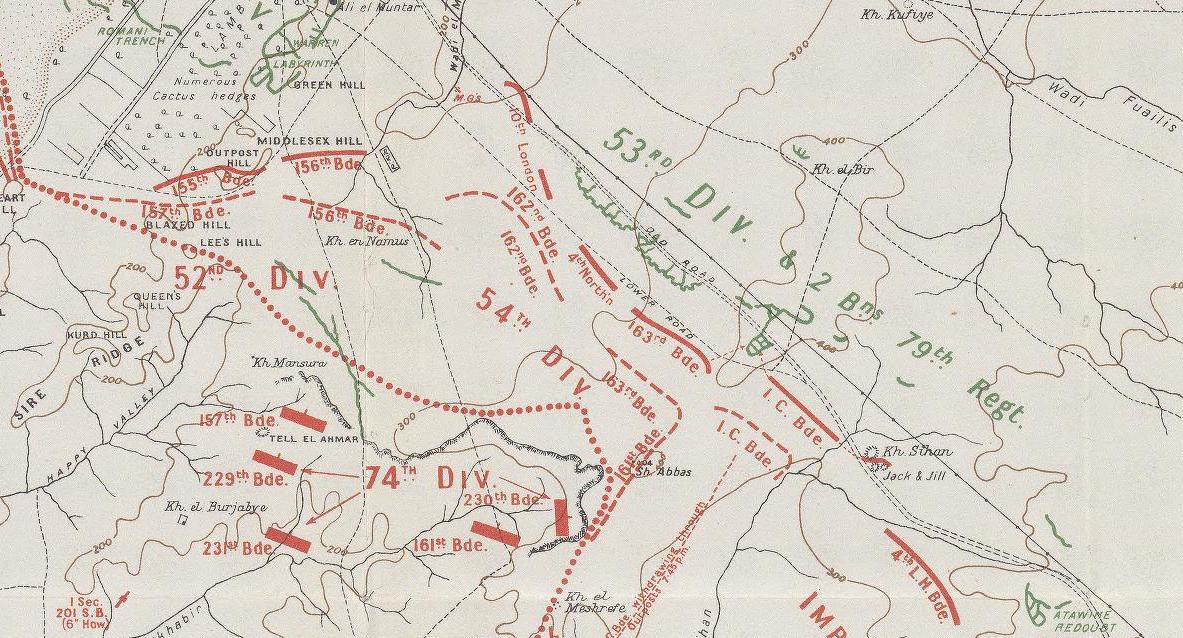
Thomas is listed as being killed in action during the Second Battle of Gaza. The 1st/4th Battalion war diary is not yet available online and the following is taken from the book “The History of the Norfolk Regiment 1685 to 1918” by F. Loraine Petre, which is available as an electronic book on the Internet Archive [Click here]. "Orders for the general attack on the 19th were issued so late on the 18th that they did not reach the men till nearly midnight, with the result that most of the night had to be spent in preparations for attack and distributing rations and water, all of which might well have been done during the day, had orders been issued earlier. The orders contemplated the attack and capture of Gaza and the formation of a new line beyond it. There was to be a heavy bombardment from 5.30 a.m. for two hours before the infantry attack began. The 163rd Brigade was to attack about Khirbet-el-Bir with the 52nd Division on its left. In the front line were the 1/5th Norfolk on the right, the 1/4th Norfolk on the left, and the 8th Hants in support, with the 5th Suffolks in reserve.
The four battalions were ready at 5 a.m. for the advance, which was to commence at 7.30 after a heavy bombardment for two hours. To the bombardment the Turks had made little or no reply, but when the infantry moved forward it soon became apparent that the British artillery had done very little harm, and the attack was met by what Captain Buxton describes as “a perfect hell of artillery and machine-gun fire.” The British artillery could not give them adequate support, as they had already fired away a great part of their ammunition and, moreover, the range of 6,000 yards was excessive. Thus, with little support, the infantry had to cross some 1,700 yards of undulating country in full view of the Turks awaiting them in trenches and well-wired redoubts beyond the Gaza-Beersheba road. At 7.30 the two Norfolk battalions advanced. Watching the first stages from brigade head-quarters, Captain Buxton writes that “it was a magnificent sight to see them going in extended order as if on a field day.” Each battalion covered a front of about 900 yards. The right of the 1/5th Norfolk was directed on a Turkish redoubt which soon began to give trouble. The first low ridge was crossed by 8.30 and the second, about 500 yards further on, was reached. The 8th Hants now moved with one tank against the redoubt on the right of the 1/5th Norfolk. On the opposite flank, the left of the 1/4th Norfolk, the other tank advanced on another Turkish redoubt, but unfortunately was hit by a shell and put out of action. The 1/5th Norfolk battalion disappeared over the second ridge and communication between the battalions became very difficult. The tank with the 1/5th and the 8th Hants was presently set on fire, but not before it had inflicted heavy damage on the enemy and sent back twenty prisoners taken in the capture of the redoubt, which was held by a party of the 1/5th Norfolk men and some of the Camel Corps. All this time the British had been suffering very heavy loss from the Turkish artillery, machine-gun, and rifle fire which the British artillery, at a range of 6,000 yards, was unable to keep down. About 10 a.m. Lieutenant Buxton, who had gone out to get information for brigade head-quarters, telephoned what he had seen from a shell hole in which he had ensconced himself. In his own words: “It is quite obvious what had happened. The advance had been held up just below the Turkish line, and one could see our men lying out in lines, killed or wounded. The 1/5th Norfolk ‘B’ company under Captain Blyth, had captured Tank redoubt and had held it for some time, till all ammunition was spent. No support came up, and so those who did not get away, sixty in all, were captured in the Turkish counter-attack. My second tank, under Captain Carr, (its noted this is the one attacking with the 1/5th Norfolks), had done very well getting into the redoubt. The first tank had had a direct hit and was burning. It was obvious that our attack here had failed, and that most of our men had been killed. So I waited a bit longer, and when things were a shade quieter, got out of my shell-hole and ran back over the rise. There I came on about forty men of our brigade of all regiments. Major Marsh, who was O.C. 8 Hants, was there too, and Lieutenant Wharton of the 4th Norfolk. These men were just stragglers and all collected there. We decided it was no good going on then, so we started to dig ourselves in. This was all quite early in the morning – about 9. Marsh had a telephone line so I phoned back to Brigade H.Q and gave them all the news. There were a lot of dead men and wounded all around us. Some of the latter we got behind our lines, in case the Turks tried a counter-attack. We were about forty men and one Lewis Gun, and no-one on our left or right for several hundred yards. The place we were holding was the top of a rounded hillock. The Turks kept us under pretty good machine gun fire all day. Marsh and I lay in a rifle pit and ate dates and biscuits for a bit. We allowed no firing, as we wished to keep our ammunition in case of a counter attack. About 4 in the afternoon the 5th Suffolks were sent up to support us and consolidate the position we held. This was really a great relief. About seven the Brigadier came out after dusk and saw the place. He ordered us to retire during the night right back to our starting point, for it would not have been possible to hold this advanced position as long as there was no-one on our flanks at all. During the day a few stragglers joined us, among them Corporal Burtenshaw and a private. He told me that Captain Birkbeck had been very badly wounded. I told the O.C. Suffolks whereabouts he was said to be. They promised to send out patrols to try and find him, but these did no good at all, as I afterwards heard. We brought in a lot of wounded as we came back. The three attacking regiments of our brigade had all had very heavy losses. Each was reduced to about 150. The 5th Norfolk lost, killed or wounded, all the officers who went in, except one, and about 600 men.” The casualties for the 1st/4th in this disastrous attack of the 19th were extremely heavy: |
| Personal & Family History |
| Birth Date/Place | Baptism Date/Place |
|---|---|
| Apr Qtr 1885 in Leamington Spa | 7 Jun 1885 at Leamington Spa, St Mary's |
| Parents Names | Abode |
| John and Ellen Matthews | 88 New Street, Leamington Spa |
| Wife and Marriage Details | Children |
| Daisy Annie Matthews nee Foot | Edwin Thomas born 3 May 1917 |
| Jul Qtr 1911 in Leamington Spa | |
| Schools | Colleges |
| ~ | |
| Address History | Employment History |
| 1885 - 24 Gordon Street, Leamington Spa | 1891 - Scholar |
| 1891 - 84 New Street, Leamington Spa | 1901 - Assistant Ironmonger |
| 1901 - 88 New Street, Leamington Spa | 1911 - Ironmongers Assistant |
| 1911 - 88 New Street, Leamington Spa | 1917 - Waring Ironmongers, Leamington |
| 1917 - 106 Lower Tachbrook Street, Leamington Spa |
