
South Warwickshire Family History Society War Memorial Transcription Project
The Fallen Men of South Warwickshire - World War One |
|
|

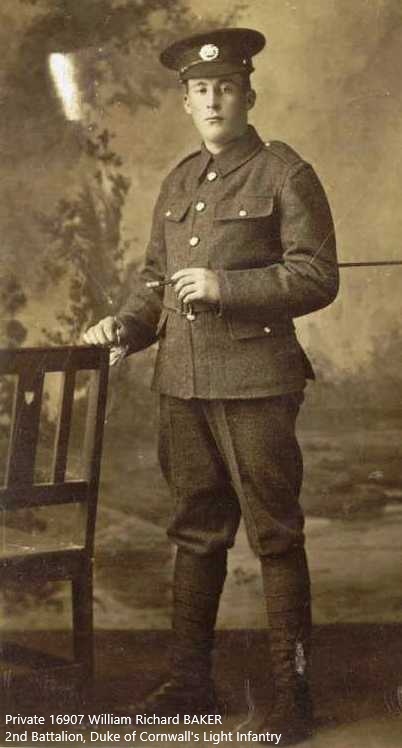
|
Military History |
| Theatre of War | Medals | Commonwealth War Grave or Memorial |
|---|---|---|
| France & Flanders | 1914-15 Sat, British War & Victory Medals | Ypres (Menin Gate) Memorial |
| Arrived in Theatre | Medal Citation (if app) | SWFHS Area Memorials |
| 7 Apr 1915 in France | ~ | Stratford on Avon WW1 Memorial |
| Stratford Holy Trinity Church | ||
| Action, Battle or Other Reason Died | Date and Place Enlisted | Stratford Cemetery Memorial |
| Battle of Gravenstafel Ridge | On or after 5 Aug 1914 in Birmingham | |
| Place of Death | Previous Regiments or Units | Other War Memorials |
| St. Eloi | ~ | |
Circumstances of Death
|
William is listed as being killed in action of 23rd April 1915. The scanned copy of the 2nd Battalion war diary is virtually impossible to read and the following is a precis of events provided by the Grok AI application. On 23 April 1915, the 2nd Battalion of the Duke of Cornwall's Light Infantry was actively engaged on the Western Front during the First World War. At this time, the battalion was part of the 82nd Brigade, 27th Division, having arrived in France from Hong Kong in December 1914. They landed at Le Havre on 21 December 1914 and had been in the trenches since early 1915. Specifically, on 22–23 April 1915, the 2nd DCLI was positioned in the Ypres Salient, near St. Eloi, during the Second Battle of Ypres. This was a significant moment in the war, as it marked the first large-scale use of poison gas by the Germans on the Western Front. On 22 April 1915, the Germans released chlorine gas against French colonial troops (Algerian and Zouave units) to the north of the 2nd DCLI's position, causing chaos and heavy casualties. The gas attack opened a gap in the Allied lines, prompting an urgent response from British and Canadian forces in the area. The 2nd Battalion's war diary and historical accounts note that, on 22 April, French troops began arriving in their trenches, fleeing the gas attack and bringing reports of the unprecedented weapon. By 23 April, the situation was fluid and chaotic. Lieutenant-Colonel H. T. Willyams, commanding the battalion, reported an encounter with a wounded and unarmed French colonial soldier who, upon learning the Cornwalls were preparing to counterattack the Germans, requested to join them. He was armed with a rifle and given a brief lesson on its use. This man joined the first wave of the 2nd DCLI's advance but was killed shortly after going "over the top." On 23 April itself, the battalion was involved in defensive actions and limited counterattacks to stabilize the line in the wake of the gas attack. The war diary indicates they faced heavy shelling and rifle fire, with casualties mounting as they held their positions or attempted to regain ground. The exact losses for that day are not isolated in summary accounts, but the battalion had already suffered its first casualties earlier in the year (e.g., two killed and fourteen wounded on 13 January 1915 at St. Eloi), and the intense fighting around Ypres added to their toll. The 2nd DCLI remained in the Ypres sector until October 1915, when they were redeployed to Salonika. The events of 22–23 April 1915 were a brutal introduction to the evolving nature of trench warfare, with the battalion enduring not only conventional combat but also the psychological and physical impact of chemical weapons. |
| Personal & Family History |
| Birth Date/Place | Baptism Date/Place |
|---|---|
| 8 Jul 1895 in Sibford Gower | 13 Oct 1895 in Sibford |
| Parents Names | Abode |
| Richard and Mary Baker | Kings Lane, Clopton, Stratford on Avon |
| Schools | Colleges |
| ~ | |
| Address History | Employment History |
| 1892 - Blenheim, Sibford Gower | 1901 - School age |
| 1901 - Grounds Cottage, Hook Norton | 1911 - Farm Labourer |
| 1911 - 2 Whimpston, Stratford on Avon | |
| 1915 - Kings Lane, Clopton, Stratford on Avon | |
- Brother of Thomas Baker who also fell just 16 days after William
