
South Warwickshire Family History Society War Memorial Transcription Project
The Fallen Men of South Warwickshire - World War One |
|
|

|
Military History |
| Theatre of War | Medals | Commonwealth War Grave or Memorial |
|---|---|---|
| France & Flanders | 1915 Star, British War & Victory Medals | Vermelles British Cemetery |
| Arrived in Theatre | Medal Citation (if app) | SWFHS Area Memorials |
| 30 May 1915 in Havre, France | ~ | Stratford on Avon Cemetery Memorial |
| Action, Battle or Other Reason Died | Date and Place Enlisted | Other War Memorials |
| Battle of Loos | September 1914 in Canterbury | Durham University Roll of Honour |
| St. Dunstans College Roll of Honour (Page 44) | ||
| Place of Death | Previous Regiments or Units | |
| Le Routoire near Vermelles | ~ | |
Circumstances of Death
|
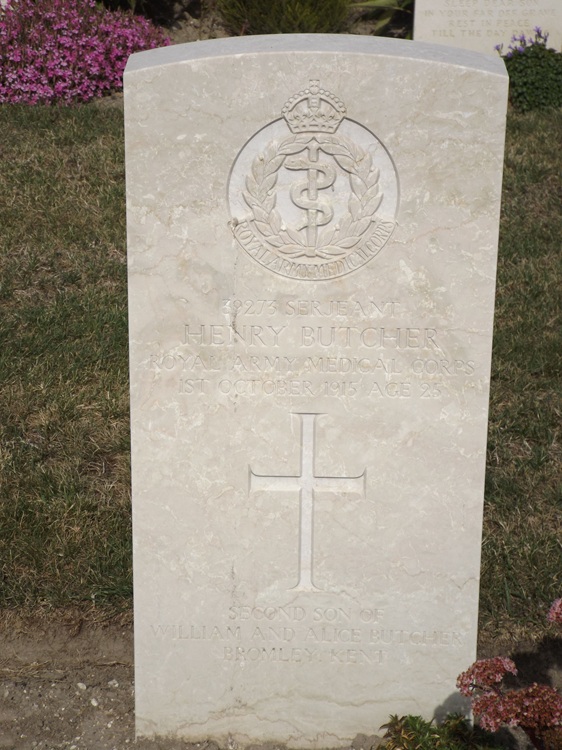
Henry is listed as being killed in action on 1st October 1915 when shell fire hit the Advanced Dressing Station of the 36th Field Ambulance. The 36th Field Ambulance War diary for 1st October is transcribed below. La Rutoir Farm - 1 Oct 1915: On October 1st, when at the Advanced Dressing Station at La Rutoir Farm, two of the M.T. Drivers, Capt Bell and 6 R.A.M.C other ranks were killed. |
| Personal & Family History |
| Birth Date/Place | Baptism Date/Place |
|---|---|
| 5 Jul 1890 in Twickenham | |
| Parents Names | Abode |
| William and Alice Butcher | 44 Tweedy Road, Bromley |
| Schools | Colleges |
| St. Dunstan's College, Catford 1902-1905 | St. Augustine's College (1911) & Durham University (1914) |
| Address History | Employment History |
| 1891 - 24 Heathfield North, Twickenham | 1901 - School age |
| 1901 - 44 Tweedy Road, Bromley, Kent | 1911 - Theological student |
| 1911 - St Augustine College, Canterbury | Clerk for South Eastern and Chatham Railway |
| 1915 - 44 Tweedy Road, Bromley | Clerk for London City and Westminster Bank |
Biography/Obiturary from Universties at War website
|
Henry Butcher was born 5 July 1890 at Twickenham, Middlesex, the second of three sons of William, architect and surveyor, and Alice Butcher. He was educated at St Dunstan's College, Catford, and then worked as a clerk first in the audit department of the South Eastern and Chatham Railway, and subsequently in the London City and Westminster Bank Ltd. He continued his education at St Augustine’s College in Canterbury from 1911 which mainly trained missionaries, and where Henry also served as a linesman and scorer for the College’s Football and Cricket teams, respectively. He became an Unattached (non-resident) member of Durham University in Easter term 1914 in order to gain a university qualification whilst still attending St Augustine’s College. He passed his first year exams in Theology that term, and would have been intending to go on to gain a Licence in Theology. Sometime after the outbreak of war he enlisted in the 36th Field Ambulance, Royal Army Medical Corps. This became the Field Ambulance in 36th Brigade, 12th (Eastern) Division. This unit was formed in August 1914 as one of the first six Kitchener divisions known as K1 Army Group. The RAMC and Engineers trained initially at Hounslow. The 12th Division went overseas between 29 May and 1 June 1915. Harry Butcher arrived in France on 30 May, presumably with the rest of his unit. The division initially went into the line in the Ploegsteert area in Flanders but was relieved on 26 September and went into the line near Hulluch on the Loos battlefield on the evening of 30 September/1 October. The operation was carried out under heavy artillery fire and 36th Field Ambulance’s Dressing Station or Field Hospital was heavily damaged by shellfire on 1 October killing him, another RAMC soldier, and two ambulance drivers. A friend from St Augustine’s College, Bruce Beale, wrote at the time, "... life is counted of small value the poor fellows fall by hundreds daily ...". Butcher’s home address was then 44 Tweedy Road, Bromley, Kent. He is buried in Vermelles British cemetery in France. A Dressing Station was located at the Château de Vermelles at this time, and it is likely that he was buried near where he fell. We have not yet found any link between Henry and Stratford on Avon. |
