
South Warwickshire Family History Society War Memorial Transcription Project
The Fallen Men of South Warwickshire - World War One |
|
1s |

|
Military History |
| Theatre of War | Medals | Commonwealth War Grave or Memorial |
|---|---|---|
| Russia | British War & Victory Medals | Murmansk New British Cemetery |
| Arrived in Theatre | Medal Citation (if app) | SWFHS Area Memorials |
| November 1918 in France | ~ | Hillmorton |
| Action, Battle or Other Reason Killed | Date and Place Enlisted | Other War Memorials |
| Allied Intervention in Russian Civil War | Commissioned 20 Sep 1918 (Gazette) | Harrow School Gates |
| Place of Death | Previous Regiments or Units | |
| near Murmansk, Russia | Officer Training Cadet | |
Circumstances of Death
|
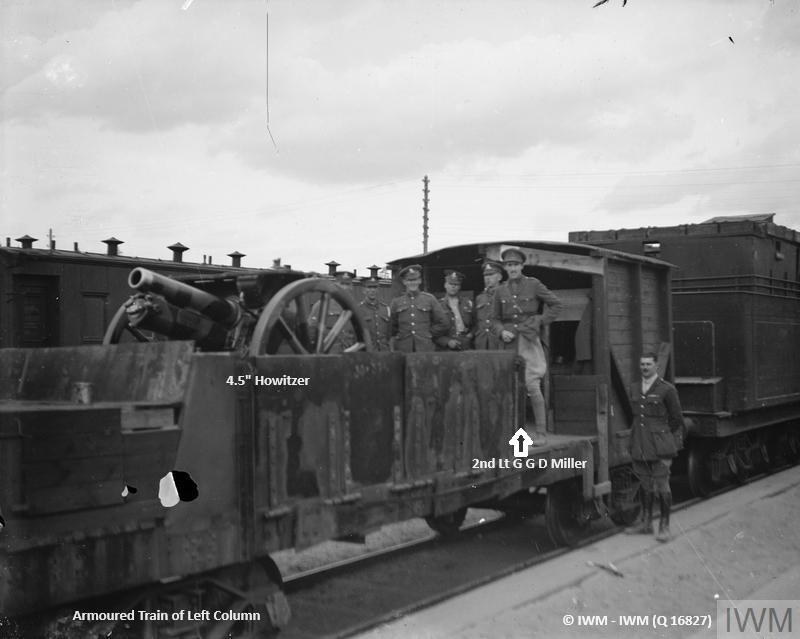
George was killed in action on 15 Sep 1919 near Murmansk, Russia. He was originally buried in the Kapaselga Churchyard, Kondopozhsky District, Karelia, Russia but his remains were moved to a new burial ground in Murmansk around 1930. The following description of the events leading to George's death is taken from "Churchill's Secret War With Lenin: British and Commonwealth Military Intervention in the Russian Civil War, 1918–20" by Damien Wright, published by Helion & Company Ltd. Click here to buy. "An attack in two columns along the entire Murmansk front, commenced on 14 September 1919 and the following day, 15 September, ‘D’ Company arrived at 1st East Surreys’ battalion HQ and replaced ‘A’ Company as advanced guard before resuming the advance at 0700. No enemy were encountered in the initial advance but there were clear signs of their hurried departure. On reaching Siding 6 the only living creature that could be found was a railway employee who was promptly taken prisoner and sent to the rear. By 0920, ‘D’ Company had advanced to within two versts north of Siding 5 from where they could observe the enemy loading a train under steam. Major Irwin deployed his scouts and began to push forward, hoping to catch the train and cargo intact. As the scouts neared the siding the enemy opened fire with rifles and machine guns from the edge of the village and northern end of the railway siding, enfilading ‘D’ Company. An attempt to storm the village failed under withering fire, the enemy’s left flank being reinforced particularly strongly. Lieutenant George Cranham took a Lewis gun forward and engaged the enemy at close quarters for an hour and a half for which he was awarded the MC whilst Lieutenant John Brown was awarded an MC Bar for leading his platoon to enfilade the enemy. At 1620, Irwin decided to pull his men back to a position 400 yards north of the village and allow the British armoured train following the advance as mobile artillery support to bombard the siding. It was not surprising that the Surreys had encountered such heavy fire: a prisoner taken on the edge of the forest reported that the train had arrived with 400 Red Finnish reinforcements on board only shortly before the Surreys had attacked. The artillery bombardment commenced at 1700 and lasted 30 minutes before another attempt was made to rush the enemy positions. The enemy put up little resistance, most of the garrison having fled during the bombardment, and both village and siding were captured along with a large quantity of rifles, ammunition and war material. ‘D’ Company continued on to the bank of the Chelbina River south of the village where forward outposts were established. During the attack the Surreys lost Corporals Alfred Lett, Herbert Mardle and James Miller killed and six others wounded whilst 2nd Lieutenant Gordon Miller, attached to the armoured train from 1203rd Battery, RFA, was also killed by an enemy sniper whilst acting as forward observer with the infantry. The son of Lt Col E.D. Miller, CBE, DSO, and Mrs Irene Miller, OBE, Gordon had been awarded the Boy Scout Gold Medal for Merit in 1912 for rescuing a drowning woman from a lake near Tarporley, Cheshire. Arriving in France in November 1918 he was too late to see any action and the following year volunteered for service in North Russia where he was killed aged just 19 years".
|
| Personal & Family History |
| Birth Date/Place | Baptism Date/Place |
|---|---|
| 23 Feb 1900 at Rugby | 17 Mar 1900 at Rugby St. Andrews |
| Parents Names | Abode |
| Lt Col Edward Darley Miller CBE, DSO and Irene Miller OBE | |
| Schools | Schools |
| Bilton Grange Preparatory School | Harrow School | Royal Military Academy, Sandhurst - Cadet (Gazette) |
| Address History | Employment History |
| 1900 - Spring Hill, Rugby | 1911 - Scholar |
| 1901 - Widdington, Clifton Road, Rugby | 1917 - Officer Cadet |
| 1911 - Bilton Grange Preparatory School | 1918 - Army Officer |
| 1912 - Harrow School (approx date) | |
| 1917 - Sandhurst (approx date) | |
- Boy Scout Gold Medal for Merit in 1912 for rescuing a drowning woman from a lake near Tarporley, Cheshire
