
South Warwickshire Family History Society War Memorial Transcription Project
The Fallen Men of South Warwickshire - World War One |
|
|

|
Military History |
| Theatre of War | Medals | Commonwealth War Grave or Memorial |
|---|---|---|
| Pacific Ocean - South America | 1914 Star, British War & Victory Medals | Portsmouth Naval Memorial |
| Arrived in Theatre | Medal Citation (if app) | SWFHS Area Memorials |
| 31 Jul 1914 | ~ | New Milverton |
| Action, Battle or Other Reason Killed | Date and Place Enlisted | Other War Memorials |
| Battle of Coronel | 13 Jul 1906 at Portsmouth | ~ |
| Place of Death | Previous Regiments or Units | |
| Pacific Ocean off Coronel, Chile | Served on numerous vessels | |
Circumstances of Death
|
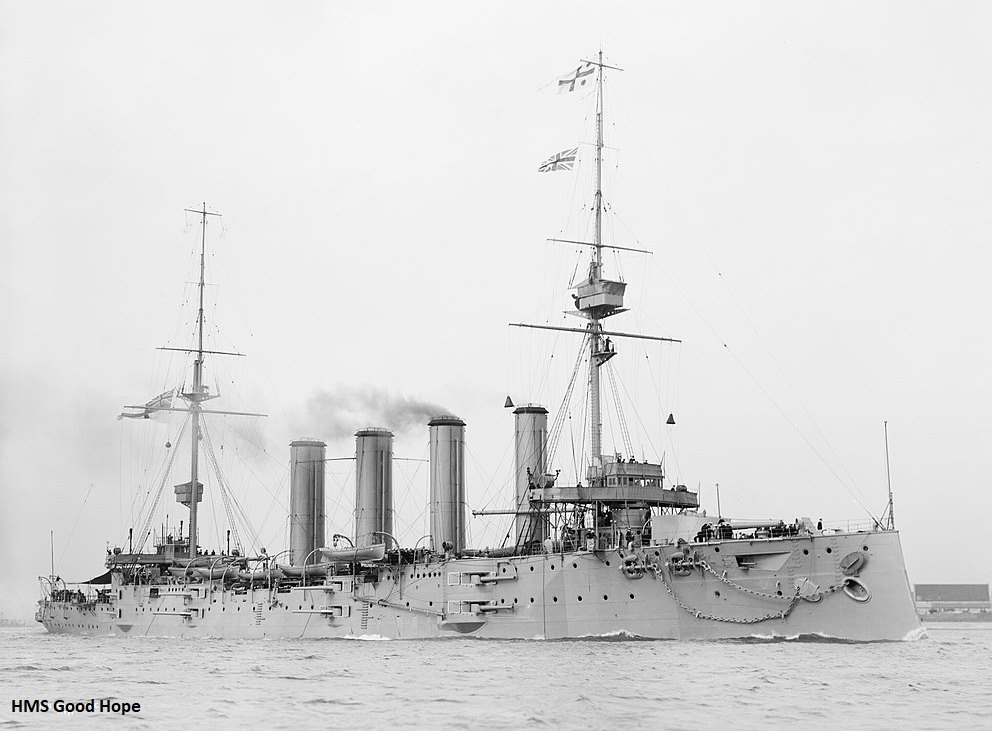
Samuel is listed as being killed in action 1 Nov 1914 when his ship, HMS Good Hope, was sunk by the German fleet off Coronel, Chile. The following description of events is taken from Wikipedia. HMS Good Hope was the flag ship of Rear-Admiral Christopher Cradock. The cruiser HMS Glasgow began to pick up German radio signals from the light cruiser SMS Leipzig on the afternoon of 29 October, and delayed entering Coronel for two days with Cradock's permission to avoid being trapped by the fast German ships. A German supply ship was already there and radioed Admiral Spee that Glasgow had entered the harbour around twilight. The cruiser departed on the morning of 1 November, but Spee had already made plans to catch her when informed of her presence the previous evening.
Spee immediately turned to close and signalled his ships to open fire at 19:04 when the range closed to 12,300 yards and Spee's flagship, Scharnhorst, engaged Good Hope while Gneisenau fired at Monmouth. Cradock's flagship was hit on the Scharnhorst's third salvo, when shells knocked out her forward 9.2-inch turret and set her forecastle on fire. Cradock, knowing his only chance was to close the range, continued to do so despite the battering that Spee's ships inflicted. By 19:23 the range was almost half of that when the battle began and the British ships bore onwards. Spee tried to open the range, fearing a torpedo attack, but the British were only 5,500 yards (5,000 m) away at 19:35. Seven minutes later, Good Hope charged directly at the German ships, although they dodged out of her way. Spee ordered his armoured cruisers to concentrate their fire on the British flagship and she soon drifted to a halt with her topsides all aflame. At 19:50 her forward magazine exploded, severing the bow from the rest of the ship, and she later sank in the darkness. Spee estimated that his flagship had made 35 hits on Good Hope, suffering only two hits in return that did no significant damage and failed even to wound one crewman.[21]Good Hope was sunk with all hands, a total of 926 officers and ratings. © Wikepedia |
| Personal & Family History |
| Birth Date/Place | Baptism Date/Place |
|---|---|
| 25 Jul 1885 at Twickenham | |
| Parents Names | Abode |
| Samuel and Mary Ann Coleman | 119 Rugby Road, Leamington Spa. |
| Schools | Colleges |
| ~ | |
| Address History | Employment History |
| 1886 - Twickenham | 1891 - Scholar |
| 1891 - 1 The Mews, Twickenham | 1901 - Harness Maker |
| 1901 - 8 Stamford Place, New Milverton | 1905 - Railway Fireman |
| 1911 - Aboard HMS Star at Portsmouth Dockyard | 1911 - Stoker 1st Class in Royal Navy |
| 1914 - 8 Stamford Place, New Milverton |
