
South Warwickshire Family History Society War Memorial Transcription Project
The Fallen Men of South Warwickshire - World War One |
|
1s
|

|
Military History |
| Theatre of War | Medals | Commonwealth War Grave or Memorial |
|---|---|---|
| France and Flanders | British War & Victory Medals | Arras Memorial |
| Arrived in Theatre | Medal Citation (if app) | SWFHS Area Memorials |
| After 1 Jan 1916 | ~ | Shipston on Stour War Memorial |
| Shipston Council School | ||
| Action, Battle or Other Reason Killed | Date and Place Enlisted | Shipston Adult School |
| German Spring Offensive (Battle of St. Quentin) | August 1915 at Birmingham | |
| Place of Death | Previous Regiments or Units | Other War Memorials |
| Ecoust / Croisselles | Pte 08219 Army Ordnance Corps | |
Circumstances of Death
|
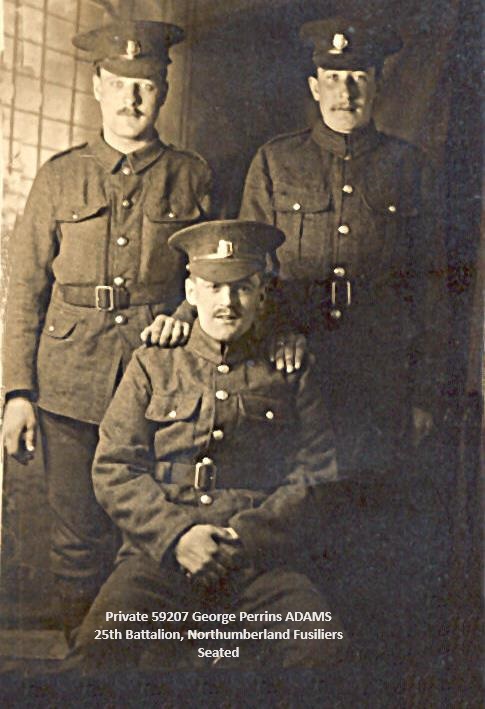
George is listed as being killed in action on 23 Mar 1918 during the early stages of the German Spring Offensive, he was originally reported as missing on between the 21st & 23rd March. A letter received by the Red Cross on 2 Aug 1918 enquiring if George has been taken prisoner shows that his death was not confirmed for some months. The following is a description of the events of the 21st & 22nd March, courtesty of Mike Wells and the Everyone Remembered website On the 21st March 1918 the Germans launched their Spring Offensive, Operation Michael, also known as the Kaiserschlact (Kaisers Battle). The Germans outnumbered the British by nearly three-to-one and punched a hole right through the British front line. Unusually they also concentrated their artillery on the British rear areas, stopping reinforcements coming forward and wrecking communications. For four hours they rained down a mixture of gas and high explosive shells. At about 8:30am there was a slight lull for 20 minutes and then the Germans started again, though this time with mainly high explosive shells. The British were in disarray along most of their front. The 34th Division however, of which George’s Battalion was a part, had made plans for an attack and they executed these and held on. At 11:50am patrols were being sent from the 25th Northumberland Fusiliers, who had been in reserve, to find out what was going on in the chaos. What they found was that the Division’s right flank was completely exposed, the troops to their right having collapsed. The 22nd Northumberlands were out on the right on their own and a company of the 25th Battalion was sent up to support their Regimental colleagues by forming a defensive flank. The three remaining companies of the 25th Northumberlands were moved to the south and formed a line facing southwest. The first company to get the order immediately sent two platoons in one direction and the other two platoons went to a ridge of land known as the Hog’s Back. As soon as they came over the crest they came under heavy fire from a huge number of enemy troops who were outflanking them and which forced them to retire rapidly. In doing so they incurred many casualties. Joining up with the other companies they pulled back together until they reached a railway line, where they turned and fought, hanging on all through the afternoon until dark. Meanwhile the Germans had advanced so far that Brigade headquarters was being attacked. The 34th Division history noted that “The single Lewis gun of the 25th, with a solitary pan, was kept going largely through the Adjutant’s coolness and skill. But in spite of all they could do the enemy closed round and all hope of relief or escape seemed gone”. At the same time the single company of the 25th sent to help the 22nd Battalion had been joined by the 23rd and all were desperately holding the line against an outflanking manoeuvre, but were incurring heavy casualties. The remnants suddenly found themselves being attacked from the left as well, and it was not until early evening that they secured their front, after some fierce fighting. Overnight on the 21st/22nd the front was re-organised and positions strengthened. The following morning in very misty conditions the Germans continued their attack and the 25th Northumberlands lost several men as they withdrew to avoid being surrounded. Over the two days the Division was pushed back nearly five thousand yards and lost 212 men killed, 1,061 wounded and 1,906 missing, a total of 3,179 men. The Evesham Journal of the 11th May 1918 reported: Mr and Mrs T H Adams have received official intimation that their eldest son, Pte George Perrins Adams has been reported missing while fighting with his regiment, the Northumberland Fusiliers, in France between March 21 and 23. Previous to joining up he was employed as stockman at Messers Gurney’s Grocery, Hereford. George’s medal index card notes ‘Presumed Dead’ and gives a good indication that he was killed on either the 21st or 22nd March 1918. On the 23rd March the battalion were relieved by the 92nd Brigade, 31st Division and marched to Ablainzeville. |
| Personal & Family History |
| Birth Date/Place | Baptism Date/Place |
|---|---|
| 22 Apr 1889 at Shipston on Stour | 26 May 1889 at Shipston on Stour |
| Parents Names | Abode |
| Thomas Henry and Sarah Martha Adams | Church Street, Shipston on Stour |
| Schools | Colleges |
| Shipston Council School 1893 | ~ |
| Address History | Employment History |
| 1889 - Church Street, Shipston on Stour | 1893 - Scholar |
| 1891 - Church Street, Shipston on Stour | 1901 - Scholar |
| 1901 - Sheep Street, Shipston on Stour | 1911 - Grocers Assistant |
| 1911 - 45 Portland Street, Hereford | 1915 - Stockman at Gurney’s Grocery, Hereford |
| 1915 - Church Street, Shipston on Stour |
