
South Warwickshire Family History Society War Memorial Transcription Project |
|
|


|
Military History |
| Theatre of War | Medals | Commonwealth War Grave or Memorial |
|---|---|---|
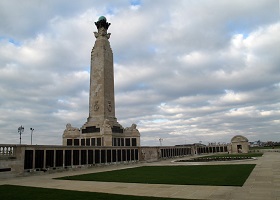
| Pacific Ocean, South America | 1914 Star, British War & Victory Medals | Portmouth Naval Cemetery |
| Arrived in Theatre | Medal Citation (if app) | SWFHS Area Memorials |
| September 1914 | Harbury | |
| Action, Battle or Other Reason Killed | Date and Place Enlisted Date | Other War Memorials |
| Battle of Coronel (Naval) | Recalled 2 Aug 1914 | |
| Place of Death | Previous Regiments or Units | |
| Pacific Ocean off Coronel, Chile | ||
Other Information
- Joined Navy on 27 Mar 1899 as a Boy aged 15
- Enlisted for 12 years on 3 Jul 1901
- Discharged 16 Jul 1913
- To Naval Reserve 16 Jul 1913
- Served on 17 different vessesl/establishments
Circumstances Leading to Death
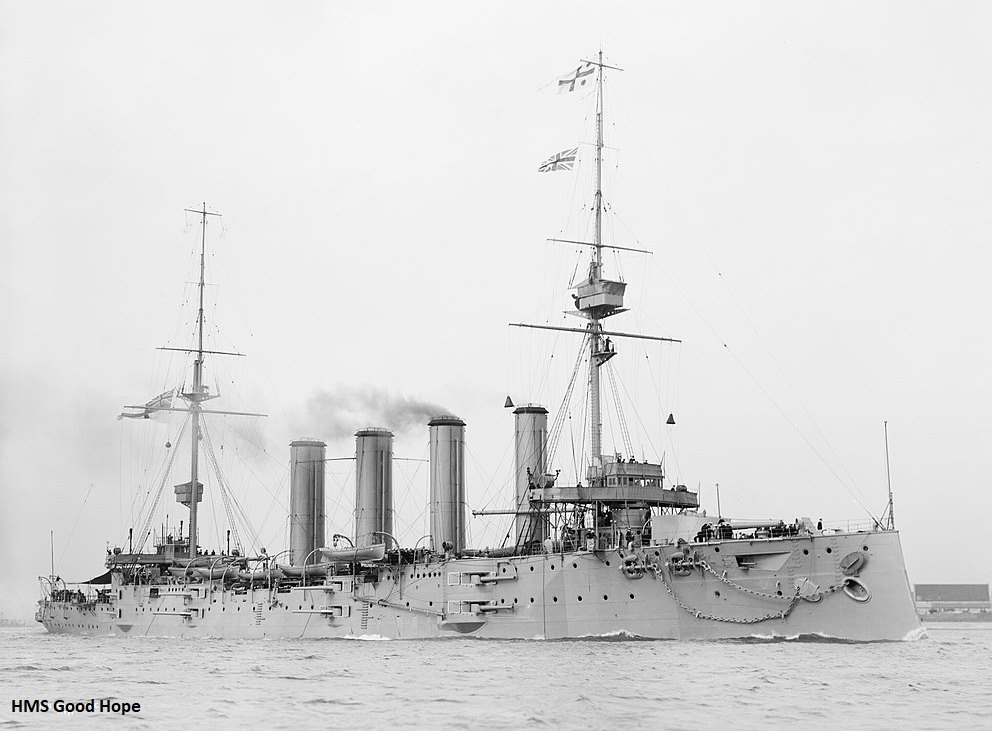
HMS Good Hope was the flag ship of Rear-Admiral Christopher Cradock. The cruiser HMS Glasgow began to pick up German radio signals from the light cruiser SMS Leipzig on the afternoon of 29 October, and delayed entering Coronel for two days with Cradock's permission to avoid being trapped by the fast German ships. A German supply ship was already there and radioed Admiral Spee that Glasgow had entered the harbour around twilight. The cruiser departed on the morning of 1 November, but Spee had already made plans to catch her when informed of her presence the previous evening.
Glasgow departed Coronel at 09:15 after having picked up the squadron's mail and rendezvoused with the rest of the squadron four hours later. Cradock ordered his ships to form line abreast with an interval of 15 nautical miles (28 km; 17 mi) between ships to maximise visibility at 13:50, and steered north at a speed of 10 knots (19 km/h; 12 mph). At 16:17 Leipzig spotted Glasgow, the easternmost British ship, to its west and she spotted Leipzig's funnel smoke three minutes later. At 17:10 Cradock ordered his ships to head for Glasgow, the closest ship to the Germans. Once gathered together, he formed them into line astern, with Good Hope in the lead, steering southeasterly at 16 knots (30 km/h; 18 mph) at 18:18. As the sixteen 21-centimetre (8.3 in) guns aboard the armoured cruisers Scharnhorst and Gneisenau were only matched by the two 9.2-inch guns on his flagship, he needed to close the range to bring his more numerous 6-inch guns to bear. The Force 7 winds and high seas, however, prevented the use of half of those guns as they were too close to the water. He also wanted to use the setting sun to his advantage so that its light would blind the German gunners. Spee was well aware of the British advantages and refused to allow Cradock to close the range. His ships were faster than the British, slowed by the 16-knot maximum speed of the armed merchant cruiser Otranto, and he opened up the range to 18,000 yards (16,000 m) until conditions changed to suit him. The sun set at 18:50, which silhouetted the British ships against the light sky while the German ships became indistinguishable from the shoreline behind them.
Spee immediately turned to close and signalled his ships to open fire at 19:04 when the range closed to 12,300 yards and Spee's flagship, Scharnhorst, engaged Good Hope while Gneisenau fired at Monmouth. Cradock's flagship was hit on the Scharnhorst's third salvo, when shells knocked out her forward 9.2-inch turret and set her forecastle on fire. Cradock, knowing his only chance was to close the range, continued to do so despite the battering that Spee's ships inflicted. By 19:23 the range was almost half of that when the battle began and the British ships bore onwards. Spee tried to open the range, fearing a torpedo attack, but the British were only 5,500 yards (5,000 m) away at 19:35. Seven minutes later, Good Hope charged directly at the German ships, although they dodged out of her way. Spee ordered his armoured cruisers to concentrate their fire on the British flagship and she soon drifted to a halt with her topsides all aflame. At 19:50 her forward magazine exploded, severing the bow from the rest of the ship, and she later sank in the darkness. Spee estimated that his flagship had made 35 hits on Good Hope, suffering only two hits in return that did no significant damage and failed even to wound one crewman.[21] Good Hope was sunk with all hands, a total of 926 officers and ratings. © Wikepedia
 |
 |
| Personal & Family History |
| Birth Date/Place | Bapitsm Date/Place |
|---|---|
| 3 Jul 1883 at Harbury | ~ |
| Parents Names | Parents Abode |
| Mary and Henry (deceased) Walker | Highfield Cottages, Harbury |
| Wife & Marriage Date/Place | Children & Year of Birth |
| ~ | ~ |
| Schools | Colleges |
| ~ | |
| Address History | Employment History |
| 1891 - Binswood End, Harbury 1901 - 1914 Highfield Cottages, Harbury (family home) |
1901 - Labourer |
Other Information
- The 1891 census shows that Jame's father Henry had died by the time he was 7 and his mother, Mary, was raising him and brothers Reginald and George in Harbury whilst working as a bag mender.
- In 1901 the census shows that James had moved away from home to join the Navy with his brothers remaining in Harbury
