
South Warwickshire Family History Society War Memorial Transcription Project |
|
|


|
Military History |
| Theatre of War | Medals | Commonwealth War Grave or Memorial |
|---|---|---|
| France and Flanders | British War & Victory Medals | Thiepval Memorial |
| Arrived in Theatre | Medal Citation (if app) | SWFHS Area Memorials |
| After 1 Jan 1916 | ~ | Stoneleigh |
| Action, Battle or Other Reason Killed | Date and Place Enlisted | Other War Memorials |
| Battle of Albert (Somme) | After 4 July 1915 at Newcastle | Matfen, Northumberland |
| Place of Death | Previous Regiments or Units | |
| Fricourt Wood | ||
Circumstances Leading to Death - Courtesy of a Great War Forum User
3 July 1916 - 7am - Day 2 of the Attack on Shelter Wood.
1st Lincolns were in Round Wood to the bend in Crucifix trench with the 10th Yorks still next to them holding a map grid of 27.b.g.6.5 to 27.b.10.1033. The 12th Northumberlands still occupied the Sunken road but had also moved some troops to Lozenge Trench, the 13th moved all its troops to Sausage support. The trench mortar battery was still in the Sunken Road and the machine gun company was moved to Dart Lane.
The only alterations to this were that the trench mortar battery had split up and had 4 tubes in Round Wood and 2 tubes in the east end of Crucifix trench. Also the machine gun company had been split down, with one section in the west of Sunken road, two sections in Crucifix trench and one in reserve in the Sunken road, displaced so as to flank Birch Tree Wood and the east side of Shelter Wood.
Brigadier-General Rawling moved his forward command post, referred to in the brigade war diary as the ‘advd battle hq’, to the junction of Patch Alley and Sunken Road at 5.30am, keeping in touch with his brigade headquarters, in the British lines, via telephone and runner communication.
The main attack was to be carries out by the 1st Lincolns, they had been given orders during the night. As discussed the battalion was to attack the woods of Birch Tree and Shelter at a moments notice. Both the shell splintered copses were in front of their frontage. The battalion as part of 62nd had spent most of 1st July moving small arms ammunition, Mills grenades and Stokes mortar shells up from their position in brigade reserve to the north of the eastern end of Patch Alley on the Sunken Road.
According to the battalion diary the original attack had been cancelled and instead they sent out men to bring in the wounded, from other units in the division, still in the field at the same time patrols reported that all was quiet in the German lines. The 2nd of July had seen fine weather and small casualties, especially in relation to those suffered on the 1st of July by other units of the division but as the 3rd morning of the month dawned the battalion once again received orders, at 5.30am, to prepare to attack.
It was to be a two company, two platoon, front attack, with ‘A’ company going in on the left , assaulting the area of the right of Birch Tree wood and the forward line of trees in Shelter Wood. ‘B’ company would then link up with the right flank of ‘A’ company who would assault through the rest of Shelter wood. Behind them ’C’ and ‘D’ companies were to follow in support with the battalion reserve who were to offer carrying party support. The furthest most right flank of the Lincolns was to link up with the 10th Yorkshire battalion.
The objective of the attack was the trench that ran along the northern edge of Birch tree and Shelter woods, which had a light railway on its right, this railway would be intuitively used later to evacuate wounded. The Lincolns would be supported by the 12th Battalion, Northumberland Fusiliers if required, with the 13th of the same regiment in brigade reserve.
A bombardment of the area began at 8.40am and this was argument by the brigades mortar battery at 8.55am who began a slow fire. At 9am the artillery lifted to the communication trenches and Quadrangle trench and the mortars intensified their salvos. Taking this as the pre-arranged signal the Lincolns leading platoons rushed from their positions to assault the enemy lines, covered by the 62nd machine gun company and the 10th Yorks.
'A’ company suffered heavily from enemy machine guns, as did its support unit, ‘C’ company, which was rushed up to help, but on the right of the attack the initial attack by ‘B’ company had better luck and ’D’ company came up and helped with consolidation of the position. Though when the Lincolns managed to reach the edge of the woods in the centre it was ’B’ company who were then were now engaged heavily in the tangle of trees and heavy fire from the Germans left in the wood which caused the attack to falter. Again the battalion bombers were used to good effect.
The Lincolns had already lost its commander, Lt-Colonel Grant DSO to a headshot and command had dissolved on to Captain T G Newbury. Many Germans had been safe in their deep dugouts in the wood and these now came out to argument the machine gun troops already engaging the British troops. As a consequence the situation was critical and one company of the 12th Northumberland fusiliers were sent up to support and vicious hand to hand fighting ensued.
At the same time the 10th Yorks were being pressed hard by German bombing parties that had attacked against Crucifix trench, this enabled a flank attack to be made against the edge of Birch tree wood. This caused some considerable pressure to the Lincolns ‘A’ company’ flank and they employed there own bombing parties to help stop the attacks. As a consequence the remainder of the 12th Northumberlands were committed to the battle in shelter wood and Crucifix trench. This helped somewhat and progress was made, albeit slowly.
By 11am the resistance was strong and the advance had become bogged down. Rawling decided to bring up the last reserve unit, the 13th Northumberland Fusiliers to the Sunken road. He then despatched them as, two companies to Shelter wood and one company to help the 10th Yorks. This left him with one company still in reserve.
An account from the 13th Northumberland Fusiliers war diary recounts an incident of the conditions for the bombers that were engaged in battle this day. It is in regard to a couple of bombing sections from ‘A’ company.
“At 9.30am on July 3rd this party under company commander moved up to Sunken road and was used for escorting prisoners and more especially for carrying up ammunition and bombs, food and water to front line in Shelter wood. Two squads of company bombers were sent as reinforcements to ‘D’ company in Shelter wood. Of these squads Corporal Skinner volunteered to go out single handed over the open and endeavour to silence a machine gun that was holding up the advance of ‘D’ company. He was with difficulty restrained and subsequently led his bombers round on the flank and silenced the gun."
By 11.30am the enemy was still hanging on in the edges of shelter wood and ten minutes later a report from was received from division that an spotter from the RFC had seen massive German movement from Contalmaison, the intention was believed to be a counter attack against Shelter wood.
It was now that Brigadier-General Rawling took the decision to finished the capture of the wood and it is probably this movement, using initiative not often seen at this stage of the war by a brigade commander that saved the day. Knowing that the wood needed to be captured in its entirety before the counter attack force arrived and knowing also that an artillery fire mission was being prepared he elected that time was short and to attack with the remainder of the reserve, one company of the 13th, and use his trench mortars as local artillery.
Major-General Campbell also saw the situation becoming dangerous and not being fully aware of the 34th division on his left committed the 63rd brigade to the flank. The strongest battalion was sent to Round wood alley with the remainder of the brigade being committed to a flanking position along Patch alley to its junction with sausage support trench (G.B.24 and 26). 64th brigade were also sent up and occupied the line from here at Pt X 20 d 7.2 (G.C.24 and 26). The result of this was that the left of 62nd brigade gained contact with 34th division around noon at position X 21 d 3.7. It would be some time before they had fully occupied these positions, in fact 62nd brigade diary indicates that 63rd brigade did not fully occupy Round wood alley until 4.30pm, they had also extended their position into Lozenge trench
The approach of the last company turned the tide and the German defenders began to surrender. Rawling then had his mortars brought up and they laid down fire on Shelter lane which stopped any further immediate reinforcement by German troops in the area. The close hand to hand fighting had lasted for almost two and a half hours .
The lack of German artillery bombardment and counter attack until 2pm almost two hours after the woods had been finally secured, left the defenders of the wood time to consolidate their positions and prepare for the German counter attack.
When it did come in the attack was relatively easily repulsed by the troops in the woods and by the brigades machine guns who had been brought up into position during the previously mentioned time. The brigade had word around 3.30pm that units of 17th division had taken Bottom wood. The yorks were able to established a better hold on a section of trench running SE from the NE corner of Shelter wood and the battalion was able to capture more machine guns, 4 in total.
Between 5pm and 5.30pm the brigade came under intense fire from German 15cm Howitzers for a short while but this seemed to be a short lived affair and caused little damage in the way of position. Brigade patrols sent out were able to report that both Quadrangle trench and Mametz wood were unoccupied but orders and strengths stopped any further advances by the brigade, though later at 6.30pm they were able to send out patrols who linked up finally with the 17th division and a consolidation of the position was able.
| Personal & Family History |
| Birth Date/Place | Baptism Date/Place |
|---|---|
| 7 Feb 1886 at Hill Wootton | 28 Mar 1886 at Leek Wootton |
| Parents Names | Abode |
| Joseph and Catherine Chattaway | Stoneleigh |
| Wife & Marriage Date/Place | Children & Year of Birth |
| Isabella Mont Chattaway nee Cooper | Jan Qtr 1916 at South Shields District |
| Schools | Colleges |
| Stoneleigh Evening Continuation School (1902) | |
| Address History | Employment History |
| 1886 - Hill Wootton | 1891 - Scholar |
| 1891 - Warwick Road, Kenilworth | 1901 - Sexton's Assistant |
| 1901 - 3 Hudson's Bridge, Stoneleigh | 1911 - Chauffeur |
| 1911 - Stoneleigh | 1915 - Coal Miner? |
| 1916 - 1 William Street, Marsden Colliery, South Shields | |
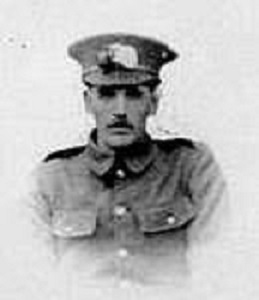
- Photograph courtesy of Stoneleigh History Society
