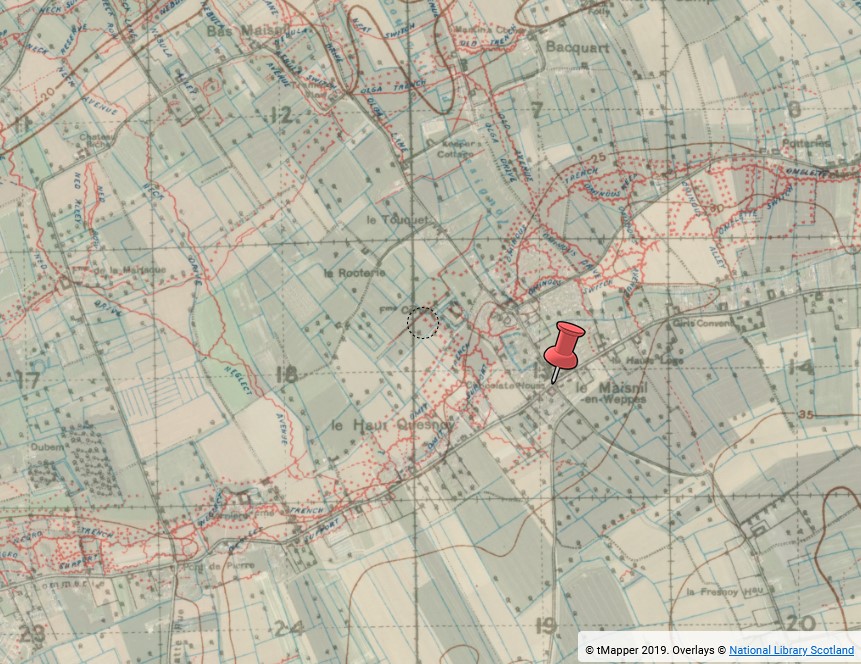
Benjamin died of wounds at the 15th Field Ambulance at Reningelst having been wounded at Hill 60, Ypres. The 1st Battalion war diary entries for the period 2nd to 4th May 1915 are transcribed below.
Hill 60, Ypres - 2 May 1915: 5am B & C Coys relieved on Hill 60 by Devons and withdrawn to 39 & 40 trenches.
4.30pm: Dorsets relieved in trenches by Devons. Dorsets withdrew to dugouts.
Casualties: 2 killed 2 wounded
Hill 60, Ypres - 3 May 1915: Bn remained in dug outs in close support of Devons.
Casualties: 1 killed 5 wounded
Hill 60, Ypres - 4 May 1915: Bn remained in dug outs in close support of Devons.
Casualties: 5 wounded
Personal & Family History
Birth Date/Place
Baptism Date/Place
Jan-Mar Qtr 1880 in Walsgrave on Sowe
28 May 1882 in Walsgrave on Sowe
Parents Names
Abode
George and Rose Jackson
Butts Croft, Corley
Schools
Colleges
~
Address History
Employment History
1881 - Combe Road, Sowe
1891 - Scholar
1891 - Ansty Road, Sowe
1901 - Bricklayers Labourer
1901 - Ansty Lane, Sowe
1911 - Coal Miner/Getter
1911 - 136 Lockhurst Lane, Coventry
1914 - Collier
1915 - Butts Croft, Corley
Benjamin's father George had lived at Butts Croft, Corley since at least 1911.
The UK Census has said that the total losses (deaths) in combat theaters from 1914–1918 were 876,084, which included 418,361 killed, 167,172 died of wounds, 113,173 died of disease or injury, 161,046 missing and presumed dead and 16,332 prisoner of war deaths.
For the men who died of wounds received on the Battlefield this website seeks to find out the circumstances of their deaths. In many cases the war diary for an ordinary Soldier or NCO's unit will not mention men by name and when preparing a Soldiers memorial page we are left to make an educated guess as to when, and often where, the soldier was wounded, which can range from a few seconds, minutes, hours, weeks, months and sometimes years before he died. The table below is designed to allow readers to make their own educated guesses as to when a soldier might have been wounded.
It should also be remembered that many men were only slightly or moderately wounded and they needed to be treated locally before being returned to the front lines and so a chain of evacution was created depending on locartions and battlefield logistics.
It can be seen above that nearly as many died of disease/sickness as did from being wounded. The below is a short guide prepared from material published by the BBC, Wikepedia, The Long Long Trail and The History Press along with the knowledge gained by us in researching our War Memorial Transcriptions (see menu items to left).
1. Self treatment - All soldiers were issued with a large bandage designed to stop non-arterial blood flow if they were unable to get treatment.
2. Stretcher Bearers - Stretcher bearers recovered the dead and wounded from No Man’s Land. They would go out at night and during breaks in the fighting. This led to them having to overcome mud, shell craters and crowded trenches, sometimes in darkness. It took four men to carry a stretcher, sometimes more in deep mud. They would carry basic medical supplies, such as bandages.
3. Regimental aid post (RAP) - A RAP was close to the front line, such as in a dugout (a hole dug in the side of a trench). Here light wounds would be treated so that soldiers could return to the front line. Those who needed more treatment were moved on to a dressing station.
4. Advanced Dressing Station - A dressing station was often set up in a tent behind the trenches. Seriously injured soldiers were moved to a casualty clearing station by a motor or horse-drawn ambulance.
5. Field Ambulance - These were mobile front-line medical units for treating the wounded before they were transferred to a Casualty Clearing Station [CCS]. List of Field Ambulances and locations
6. Casualty Clearing Stations (CCS) - A CCS was the first medical facility in which the moderately seriously wounded would receive treatment. Here, soldiers were treated by doctors, nurses and surgeons. A CCS contained operating theatres, mobile X-ray machines and hospital ward beds. A CCS would normally have a nearby Cemetery(s) where they buried the soldiers who did not survive. List of CCS and Locations
7.1 Ambulance Trains - Railway carriages converted into hospital wards created in 1914 because of the necessity of having to treat sick and wounded servicemen urgently, and the task of moving them away from the Front to hospitals and other places of recuperation. Used to transport men away from CCS.
7.2 Ambulance Barges - Same as Ambulance trains, although slow, the journey was smooth and this time allowed the wounded to rest and recuperate. However there are incidences, particularly in the Mesopotamia theatre where they became extremely unsanitary and overcrowded with near intolerable conditions which caused many deaths.
8. Hospital Ships - Most hospital ships were requisitioned and converted passenger liners. Despite the excellent nursing and medical care many patients died aboard because of their extreme wounds. The risk of torpedoes and mines as they travelled from Battlefields to Home bases was very real. List of WW1 Hospital Ships.
9. Base/Field/Stationary/General/Isolation hospitalsin Theatre - A base hospital was where civilians and serious injuries were treated. They were usually in large converted buildings. A base hospital had operating theatres, X-ray departments and specialist centres for treatment of specific problems, such as gas poisoning. The wounded would arrive here by train or motor ambulance. Normally located next or near to a local cemetery(s)
10. General & Isolation Hospitals in UK - Where either existing Military Hospitals or large houses, institutions, estates etc. that were converted to Hospitals . Normally located next or near to a local cemetery. List of British Military Hospitals (not exhaustive)
11. Convalescence Homes/Hospitals - Places where soldiers completed their recovery or available treatment before returning to the front or being invalided out of the army (Silver Badge holders)
Chain of Evacuation Diagram
Courtesy of the Visitors Centre at the Lijssenthoek Military Cemetery
Due to his being sent to France in Nov 1914 tt is believed that William had previously served or was in the territorial reserve (or both).
Circumstances Leading to Death - Full Transcript of War Diary 18 Dec 1914
The Bn was ordered to advance in 3 lines at 4.30 pm to attack & take the German Trenches which were in front of le MAISNIL. The attack was proceeded by a heavy artillery bombardment by our artillery to which the enemy made hardly any reply. Attack was started by "B" Company on the right, led by Capt Haddon, advancing in 2 lines : A Co advanced on the left in 2 lines with D Coy in the centre. "C" Coy formed the third line with entrenching tools. A Machine Gun was on each flank. Immediately the attack was opened, the enemy opened a very heavy rifle & machine gun fire. The Battalion advance under this with steadiness, suffering very heavy casualties. The 2/Queens sent in 1 1/2 companies in support & although our dead were found only a few yards from the German trenches, the attack failed in its objectives. What remained of the Bn. subsequently retired into our trenches. Shortly after daylight the enemy came out and started examining our dead. Parties went out fr. our lines & buried some of the officers and collected discs from some of the killed. Owing to 2 officers of the Queens & several small parties of the Bn, when engaged in carrying our wounded into the enemy's lines, (the enemy refusing to allow us to remove our wounded) being made prisoners, & also to Lt Bover S. Staffords being killed while helping to collect our wounded, the informal armistice was terminated. Lt. Col Brewis was found killed about 40 yards from the ememys line. Capt. Brownfield, Lts. Monk, Tucker, Campbell & Birt (attached R.E.) together with 34 men were found a few yards from a German Machine gun, from evidence available it is apparent that Capt Brownfield though previously wounded continued to lead the attack on the Gun."
Personal & Family History
Birth Date & Place
9 Dec 1872 at Bubbenhall
Baptism Date & Place
19 Jan 1873 at Bubbenhall
Parents
Edward and Sarah Hewitt
Wife & Marriage
Louisa Emily nee Gardener Oct Qtr 1903 at Coventry
Children
William Charles b1904
Olive May b1905
Violet b 1909
Occupation(s)
1904 - Engine Driver
1911 - Engine Driver
Schools & Colleges
Address History
1872 - Bubbenhall
1881 - Wasperton
1904 - 7 Eagle Street, Coventry (baptism of William)
Circumstances Leading to Death (Normally from War Diary)
The battalion took part in the advance towards Monchy and captured positions at Les Fosse's Farm where they consolidated. Bernard was killed during this operation.
Frank originally enlisted on 8 Sep 1914 at Coventry at Pte 5450 10th Bn, Royal Warwickshire but was discharged on 13 Sep 1914 as being medically unfit (varicose veins)
Circumstances Leading to Death (Normally from War Diary)
The 95th Company were in the front lines and supported two attacks by 95th Brigade in the days before he was wounded and therefore we cannot, with any certainty say whether he was wounded near Sandpits at Ginchy between the 17th to the 21st Sept or Morval between the 24th and 25th. No details at all of casualties are given in the war diary.
Personal & Family History
Birth Date/Place
Bapitsm Date/Place
Jan Qtr 1894 at Whichford
7 Jan 1894 at Whichford
Parents Names
Parents Abode
Albert and Helen Boiles
4 Springfield Terrace, Harbury (CWGC)
Wife & Marriage Date/Place
Children & Year of Birth
~
~
Schools
Colleges
~
Address History
Employment History
1901 - Toll Gate Cottage, Frankton
1911 - Farm Labourer
1911 - Whitmore Park, Keresley, Coventry
1914 - Waggoner
1914 - Whitmore Park, Keresley, Coventry (attestation form)