
South Warwickshire Family History Society War Memorial Transcription Project
The Fallen Men of South Warwickshire - World War One |
|
|

|
Military History |
| Theatre of War in Which Died | Campaign & Bravery Medals | Commonwealth War Grave or Memorial |
|---|---|---|
| Africa | 1914-15 Star, British War & Victory Medals | Freetown Memorial, Sierra Leone |
| Croix de Guerre (France) | ||
| First Arrived in Theatre | Queens South Africa Medal & 5 Clasps | SWFHS Area Memorials |
| September 1914 in Freetown, Sierra Leone | Kings South Africa Medal & 5 Clasps | Leamington Spa War Memorial |
| Leamington College for Boys | ||
| Action, Battle or Other Reason Died | Date Commissioned | Leamington All Saints Plaque |
| Kamerun Campaign | 25 Feb 1900 | |
| Other War Memorials | ||
| Place of Death | Previous Regiments or Units | St Lawrence Church Memorial, Bovingdon |
| near Wum Biags, Cameroon | 3rd Bn South Wales Borderers | Memorial Hall Plaque, Bovingdon |
| Dover College Memorial Screen |
Previous Military Service
- 25 Feb 1900 - Commissioned to 2nd Lieutentant in South Wales Borderers (Gazette)
- 26 Mar 1902 - Appointed Honourary Lieutenant
- 5 May 1909 - Promoted to Captain in Loyal North Lancs (Gazette)
- 14 Aug 1910 - Promoted to Major with Glenalmond School Contingent (Gazette)
- Nov 1913 - Former Aide-de-Camp to the Governor General of Sierra Leone
- 9 Dec 1916 - Poshoumorous Award of the Croix de Guerre by President of France (Gazette)
Circumstances of Death
|
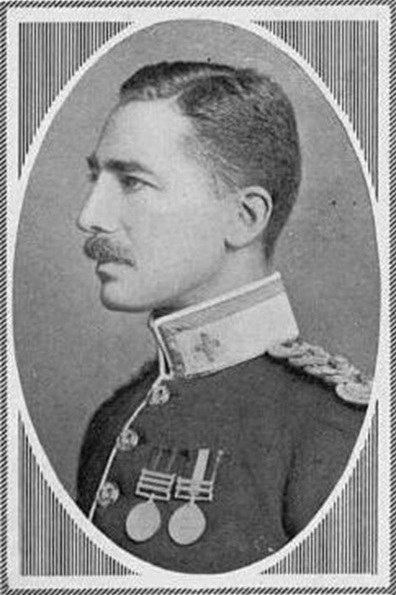
Harold was killed in action on 28th May 1915 when he led an attack on enemy lines near Wum Biags, Cameroon. The following description of events is courtesy of the Herts at War website. Harold served as the Officer Commanding, Lines of Communication, Allied Forces, Cameroon In April, 1915, Major Griffith had arrived and formed a camp at Wum Biajas on the Mbila River. Furious fighting had been going on ahead for days and nights; the sick and wounded were continually coming to him. His lines of communication were cut behind him and several cyclist and runner messengers had been sniped at previously and had to return. The condition of things was serious, but on the 27th an orderly with a strong patrol of six men and a civilian, got through and no sign of the enemy. A very large convoy of sick and badly wounded – nine officers among them – was waiting to be evacuated to the base, so early on the morning of 28 May they moved out, a strong advance guard going on ahead nearly two hours earlier. Time passed, and Major Griffith, with his hands full of other duties, hoped all was well; but about 11 a.m. he received a message from the officer in charge of the convoy saying their advanced guard had been attacked and had retreated before the Germans, and that the convoy was trying to return; but the enemy were in great force. He was greatly upset at the idea of the convoy of invalids being in danger, and immediately decided to go himself to their rescue with all the available men he could take away from the Redoubt (about 40 British and French black troops). About a mile out he met the head of the convoy and saw them safely off on their way back to camp; he proceeded on with his little band of troops, picked up the “Advance Guard” that had retreated (about another 20 men) , and took them along with him. About a mile further on he came in touch with the enemy; fighting for about 1 1/2 hours, he drove them back over a mile along the road (dense Bush on either side). Coming to a slight clearance, he ordered a “Final volley”, and then “Fix bayonets” “Charge!”. He himself led the charge-even in advance of his Advance Guard-only, however, to fall mortally wounded when he had got about 12 paces. His body was unable to be moved owing to the ambulance men (native carriers) bolting. The following day a patrol went out and found a grave close to where he fell on which the German foe had pinned a small crop of palm leaves. His brother officers erected a large cross at the head of his grave, and every convoy that passed afterwards, British or French, saluted “the Beloved Major’s” resting place. |
| Personal & Family History |
| Birth Date/Place | Baptism Date/Place |
|---|---|
| 9 Aug 1878 in Bovingdon, Herts | 23 Sep 1878 at Bovingdon St. Lawrence |
| Parents Names | Abode |
| Walter (died 1879) and Helen Mary Griffith Meyer | Holmby House, Eastnor Grove, Leamington |
| Schools | Colleges |
| Leamington College for Boys | Dover College, Kent 1890-1893 |
| Address History | Employment History |
| 1878 - Old Vicarage, Bovingdon, Herts | 1900 - 2nd Lt in Loyal North Lancs |
| 1881 - 44 York Street, Marylebone, London | 1903 - Assistant Master at Dover College |
| 1891 - Leamington Spa? | 1910 - Major in Loyal North Lancs |
| 1893 - Hotel Guisard, Lausanne | |
| 1900 - South Africa with British Army | 1914 - Major in Loyal North Lancs & Aide de Camp |
| 1902 - Austria | |
| 1903 - Deal, Kent | |
| 1906 - Northern Nigeria | |
| 1915 - Holmby House, Eastnor Grove, Leamington | |
- Awarded the Lord Roberts Silver Award of Merit for services to the National Service League
- F.R.G.S. of the Royal Horticultural Society
- Fellow of the Society of Antiquaries of Scotland
Education (Dover College Register)
- 1893 - College Galliard, Lausanne;
- S. Kensington, and Siade Schools of Art;
- 1902 - Tutor to Col. H.S.H. Prince Schonburg Hartenstein of Austria
- 1903 - Modern Language Master, Warden House, Deal
- Founder and Hon. Sec., Deal Branch Nat. Service League
- Hon. Sec. for Greenwich Branch National Service League
- Senior Asst. Master, Founder of O.C. Cadet Corps, Stratheden House, Blackheath
- 1906 - F.R.G.S. Vice-President, Kent Tariff Reform League
