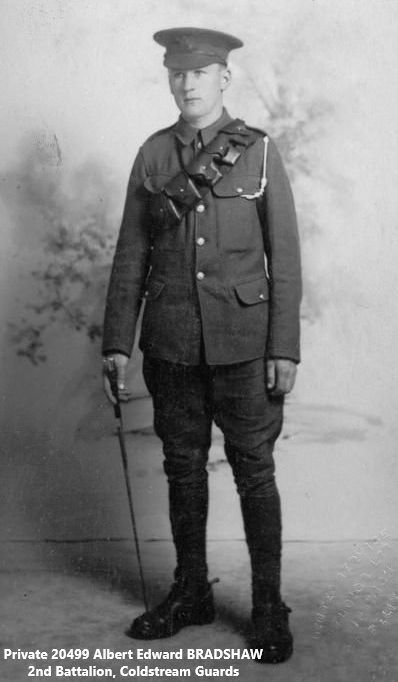
Albert is listed as dying of wounds on 30th August 1918 at the 1st Australian General Hospital in Rouen. It is most likely that he was wounded on 26th or 27th August The 2nd Battalion war diary entry for and the Battalion Report on Operations 26th-27th August are transcribed below.
War Diary
Front Line Trenches - St. Leger - 27th: At 7am the Battalion attacked. A detailed account of the operations is attached as Appendix A.
Casualties 10 officers killed or wounded. Other Ranks: 55 killed, 57 missing 6 wounded and missing, 192 wounded and 4 wounded remained at duty.
Report on Operations - Appendix A
In the evening of the 26th August, orders were issued from divisional headquarters for the attack to be renewed the following morning, the objectives being the high ground north and south of Longatte and Ecoust, but the advance was not to be pressed if the enemy’s resistance proved obstinate. The 62nd Division was to advance on the right and the 56th Division on the left of the 1st Guards Brigade, zero hour being 0700, and the line from which the attack was to be launched ran from Camouflage Copse to the Crucifix and then bent northeastward through St Leger Wood at the northern extremity of which the line of the 56th Division began.
At 0500 the 1st Guards Brigade HQ was informed that the attack by the 56th Division was being postponed to 0930 as it was thought, having captured some prisoners on the 56th Division Front, the Germans may have established the exact time of the attack, but it was impossible for the Brigade to change the time of their planned attack as the attacking battalions were in their starting positions. It was impossible to get in touch with them all quickly enough to prevent some of them at any rate from advancing at the original time. On the right the 2nd Battalion Grenadier Guards were to attack, the Coldstreams on the left with the 1st Battalion Irish Guards in reserve. The Coldstreams had No 4 Company in front, No 2 and No 3 in left and right support and No 1 in reserve. As soon as the British field gun barrage came down at 0700 the leading company advanced, followed by the supports at 200 yards distance and by the reserve company 400 yards in rear of the supports. The enemy was expecting the attack and immediately opened upon the men a very heavy fire. The postponement of the attack by the 56th Division enabled the Germans in the village of Croiselles, which commanded the left and centre of the advance, to concentrate on the Coldstreams. In a short time the right was held up, by machine-gun fire from Banks trench which appeared to have been little damaged by the British shell fire; the centre got somewhat further forward, gaining the crest line beyond St Leger reserve trench when it was also checked; the extreme left made most progress and captured many prisoners on the sunken roads running south from Croiselles. Bunhill trench was gained and consolidated under heavy fire which came from Croiselles, east of that village and also from Bunhill reserve trench.
One company of the Coldstreams reached the final objective, but without sufficient support and, being counter-attacked on its exposed flank, had to withdraw. The situation could not be restored by companies in support or reserve who were soon absorbed into the fighting line while the Germans, moving up machineguns under cover of their trenches, swept the ground and brought the attack to a standstill. Withdrawal from this untenable position was safely accomplished, but not before severe losses were inflicted on the enemy both in prisoners taken and men killed. A heavy bombardment was maintained upon the British line throughout the morning and the position was becoming critical as some of the Coldstream groups were taken in the flank by hostile fire. Two platoons of No 2 Company were reduced to 18 men; another of No 1 Company was enfiladed from both flanks; most of the officers were casualties and the whole Battalion now barely mustered 140 all ranks. In these circumstances the left and centre were withdrawn to St Leger reserve, which was close to and joined Banks Trench, and which was then occupied by a company of the Irish Guards, though still partly held by the enemy. For the rest of the morning the British heavy guns put down a concentration on the sunken roads and did great execution among the enemy.
Owing to the heavy casualties suffered by the Coldstreams, two companies of the Irish Guards were ordered up to make good the line of St Leger reserve, reinforcing the British right group and protecting that flank. The 2nd Battalion of the Grenadier Guards, on the right of the Coldstreams, had an equally heavy task to perform and also found themselves engaged in very severe fighting. However the check which the Brigade sustained during the day did not last very long, and the determined resistance of a few brave Germans armed with machine-guns, and concealed under cover, was overcome in the evening. At 1900 an intense barrage was put down on the hostile position for ten minutes and the moment it lifted the Irish Guards and the Coldstreams on the right rushed in and immediately captured it. The garrison, consisting of one German officer and 93 other ranks, surrendered with their machine-guns. During the night and the next day, the 28th, the enemy retired pursued for nearly a mile by the Brigade who then halted and consolidated the positions gained. The losses in the Battalion were 3 officers killed in action, 7 officers wounded and 111 other ranks killed in action and 189 wounded [including Albert].