South Warwickshire Family History Society War Memorial Transcription Project
The Fallen Men of South Warwickshire - World War One |
|
|

|
Military History |
| Theatre of War | Campaign Medals | Commonwealth War Grave or Memorial |
|---|---|---|
| France & Flanders | British War & Victory Medals | Ypres (Menin Gate) Memorial |
| Arrived in Theatre | Bravery & Conduct Medals | SWFHS Area Memorials |
| After 1 August 1916 in France | ~ | Leamington Spa War Memorial |
| Leamington St. John's Memorial | ||
| Action, Battle or Other Reason Died | Date and Place Enlisted | |
| Battle of Pilkem (Passchendaele) | After 31st July 1916 in Leamington Spa | |
| Place of Death | Previous Regiments or Units | Other War Memorials |
| Pilkhem Ridge | Pte 235017 1st/5th Royal Warwicks | ~ |
Circumstances of Death
|
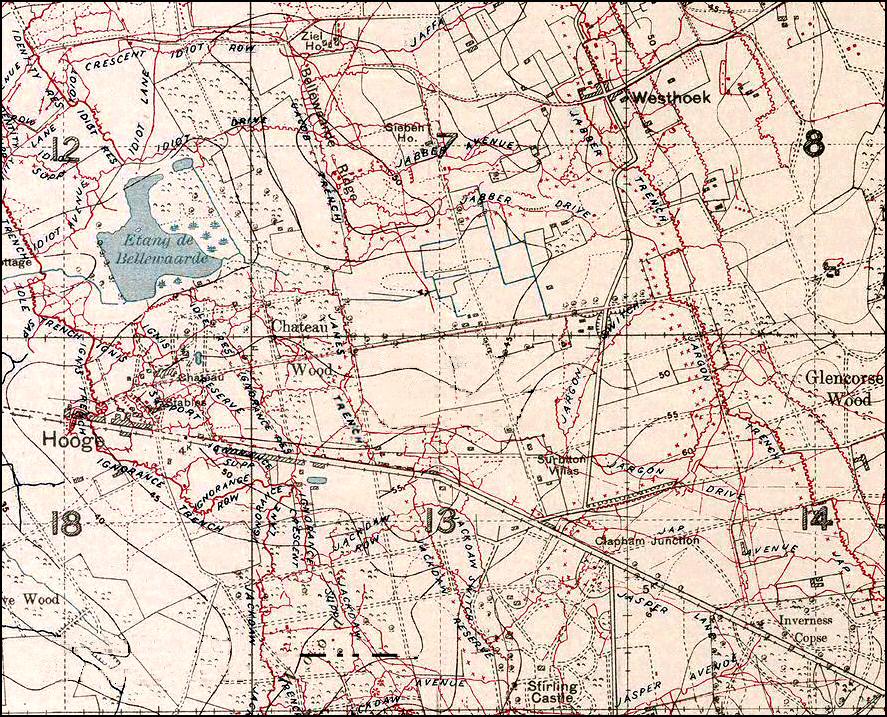
Harry is listed as being killed in action on 31 Jul 1917. The war diary and the below article from the Worcestershire Regiment website describe the events from 30th July to 3rd Aug 1917. Please also see the Leamington Courier obituary which has also been transcribed below. War Diary Extract/Website ArticleDuring the night of July 30th/31st the British guns redoubled their fire, and as the first light of dawn broke the sky [3.50am on 31 Jul 1917] the gun-fire rose to intensity and along the whole front of the Salient the British infantry went "over the top." The great attack had begun. Following close behind the creeping barrage,"C" and "D" Companies of the 1st Worcestershire swept forward over the enemy's front and support lines. Little opposition was met. The organisation of the attack had been careful, and "mopping up" parties dealt with the enemy dugouts in quick succession. The existence of a tunnel under the road, behind the enemy's lines, had long been known, and it had been anticipated that it would give much trouble; but in the event it was captured easily enough, and forty cowering prisoners were extracted. The ground over which the platoons advanced was a wilderness of shell-holes, and intermittent rain during the previous days had begun to soak the soil. At the German support trench ("Ignorance Support") the two leading companies called a- halt and started to dig in, while "A" and "B" Companies, hitherto in second line, passed through, advanced through the tree stumps of Chateau Wood and captured James Trench. Then came the first definite opposition, a hail of machine-gun fire, and a heavy barrage of shells from the enemy guns. Fortunately the German shells fell upon Chateau Wood, behind the advancing companies; but the machine-guns were a serious problem. The objective of the two companies was a small spur which projects southward from the Bellewaerde Ridge. On the spur were several concrete block-houses. Several had been smashed by our shells, but one was still intact. From that cover the enemy used a machine-gun with great effect, and the advance was checked. Lieutenant E. C. Barton led forward a small party, Sergeant W. Moore and nine men.Working their way from shell-hole to shell-hole they advanced some five hundred yards under heavy fire, closed in on the block-house and rushed it, killing or capturing all its garrison. Lieut. Barton was awarded the M.C. Sergt Moore was awarded the D.C.M. Further along the line the advance was held up by a light machine-gun firing from a shell-hole. Two Lewis-gunners, Lance-Corporal C. Richards and Private S. Fudger, brought their weapon into action. The German machine-gun ceased fire, but reopened as soon as the advance was resumed. The two Lewis-gunners promptly attacked. The Lance-Corporal shot down the German gun-team with his revolver and captured the machine-gun. L/Cpl. Richards and Pte. Fudger were awarded the D.C.M. Those brave deeds enabled the advance to continue. The attacking platoons breasted the slope, crossed the sky line, and dug in on their objective, the forward crest of the spur, facing the Westhoek Ridge. On the left the 2nd Northamptonshire had stormed the ruins of Hooge and Bellewaerde Farm and had gained the highest ground of the Bellewaerde Ridge. The first phase of the attack had been triumphantly accomplished. Then, according to the plan, the two supporting battalions of the 24th Brigade were to come through and take the next objective. Tanks were to assist in that second phase, and soon the tanks were seen approaching, lumbering forward over the captured trenches; but the boggy ground rendered their movements slow and clumsy, most of them were "ditched" or broke down, and the only one which came past the Battalion was hit and destroyed by shell-fire. The enemy's gun-fire increased. Under a rain of bursting shells the 2nd East Lancashire advanced through the lines of the 1st Worcestershire and pressed on to attack Westhoek. The fire was too fierce to permit of final success, and presently the East Lancashire, after losing heavily, were forced to halt and dig in short of their objective. The reserve of the 8th Division, the 25th Brigade, came up in their turn. The 2nd Lincolns passed forward through the lines of the Worcestershire, but the enemy's resistance had stiffened, and the Lincolns suffered severely during their advance from machine-guns in Glencorse Wood. Eventually the Lincolns and East Lancashire consolidated a line which ran in a shallow semi-circle facing Westhoek. On the right flank the position was exceedingly dangerous. The 30th Division had not succeeded in advancing beyond "Stirling Castle" and from the high ground about "Glencorse Wood," several machine-guns were firing. Those machine-guns could take the 8th Division front in enfilade, and counter-attacks were also threatened. To protect the right flank Colonel Davidge led forward two companies of the 1st Worcestershire. He formed them as a defensive flank facing Inverness Copse, with the object of linking the line of the 8th Division with that of the 30th Division at Stirling Castle. For his brilliant leadership on that occasion Colonel Davidge was awarded the D.S.O. His Adjutant, 2/Lt. W. C. Stevens, was awarded the M.C. Intense gun-fire continued throughout the day. The morning had been dull and cloudy. Towards the evening heavy rain came on and continued into the night, obscuring the view and soaking both the troops and the ground beneath them. Casualties were counted—well over 200, including 9 officers. Killed 4 officers (Capt. F. J. O'Brien, 2/Lt. E. S. Collins, 2/Lt. H. C. Stephens, 2/Lt. R. A. Budden) and 22 other ranks. Wounded 5 officers (Lt. E. C. Barton, 2/Lts. R. A. Hart, G. N. Perham, G. B. Harrison and T. Comoys) and 157 other ranks. Missing 49. The Battalion had captured 70 prisoners as well as a machine-gun. That night and the following day [1 Aug 1917] were miserable. Under pouring rain the officers and men of the 1st Worcestershire held firm on the ground they had won, digging in as best they could, while the enemy's fire swept the ridge. Late in the day word came of relief, and presently the relieving Battalion came splashing their way up through the mud; and proved to be none other than the 3rd Battalion of the Regiment. The relief took some time, but eventually the 1st Battalion got clear and marched back down the Menin Road, while the 3rd Battalion Worcestershire settled down to take their places. After their relief on the Bellewaerde Ridge the 1st Worcestershire had marched through Ypres to Devonshire Camp (near Halifax Camp) and thence, after an issue of dry clothes and a night's rest, had moved to Steehvoorde on August 3rd. Now they were due for the line again, and on August 14th, after a cheery farewell from the 3rd Battalion, the 1st Battalion marched off, forward, to Halifax Gamp. Two companies were sent on ahead in lorries to lay duck-board tracks in the battle-area (Those two companies came under shell-fire next day and lost 1 killed and 3 wounded.). The remainder of the Battalion spent a night at Halifax Camp and then marched on into Ypres, in preparation for the next battle. Leamington Spa Obituary - November 9th 1917Private Harry Lewin, Worc. Regt., previously reported missing since July 31st last, is now officially reported to have been killed in action or to have died of wounds. His body was found on the battlefield by men of the Machine Gun Corps five weeks after having gone into action He formerly lived at 60, Court Street, and leaves a widow, named Edith, and three children. By trade Private Lewin was an iron polisher, but until he joined up at the end of last year he was for some time employed at Courtaulds, Coventry. His company officer writes: "Please accept the deepest sympathy which the officers, N.C.O.'s, and men of the Company have for you in your loss. I commanded the Company on the day in question, and I can assure you that you husband did his duty to the end. Every man who went over was a hero. They were wonderful". |
| Personal & Family History |
| Birth Date/Place | Baptism Date/Place |
|---|---|
| 14 May 1882 in St. Helens, Lancs | 26 Jul 1885 at Coventry Holy Trinity |
| Parents Names | Abode |
| John and Rosanna Lewin | John died in 1903 and Rosanna died in 1912 |
| Wife and Marriage Details | Children |
| Caroline Louisa Lewin nee Bolt | Walter b 13 Mar 1909; Norah b 25 Dec 1911 |
| Oct Qtr 1908 in Leamington Spa | Robert b 15 Jun 1913; William 8 Feb 1918 |
| Schools | Colleges |
| ~ | |
| Address History | Employment History |
| 1885 - Lancastrian Yard, Coventry | 1891 - Scholar |
| 1891 - 50 West Orchard, Coventry | 1901 - Cycle Polisher |
| 1901 - 12 Court, 4 House, Thomas Street, Coventry | 1911 - Iron Polisher |
| 1911 - 7 Buchanan Street, Leamington Spa | 1913 - Iron Polisher |
| 1913 - 7 Buchanan Street, Leamington Spa | 1916 - Employed at Courtaulds, Coventry |
| 1917 - 60 Court Street, Leamington Spa |