South Warwickshire Family History Society War Memorial Transcription Project
The Fallen Men of South Warwickshire - World War One |
|
|

|
Military History |
| Theatre of War | Campaign Medals | Commonwealth War Grave or Memorial |
|---|---|---|
| France & Flanders | British War & Victory Medals | Chester Farm Cemetery |
| Arrived in Theatre | Bravery & Conduct Medaks | SWFHS Area Memorials |
| 1 Oct 1916 in France | ~ | Warwick School Chapel Memorial |
| Action, Battle or Other Reason Died | Date and Place Commissioned | Other War Memorials |
| Battle of Messines | 26 Aug 1915 into Royal Warwickshire Regt | Solihull School Memorial |
| St. Michaels, Stoke, Coventry | ||
| Place of Death | Previous Regiments or Units | |
| near Messines, Ypres | 13th Bn Royal Warwickshire | |
Military Service History
- 11 May 1915 - Harold received his Flying Certificate on 11th May 1915 at Hendon Flying School
- 26 Aug 1915 - Commissioned as 2nd Lt in Royal Warwickshire Regt (Gazette)
- 28 Feb 1916 - Transferred to RFC
- 01 Oct 1916 - Arrived in France
- ?? Mar 1917 - Promoted to Captain
Circumstances of Death
|
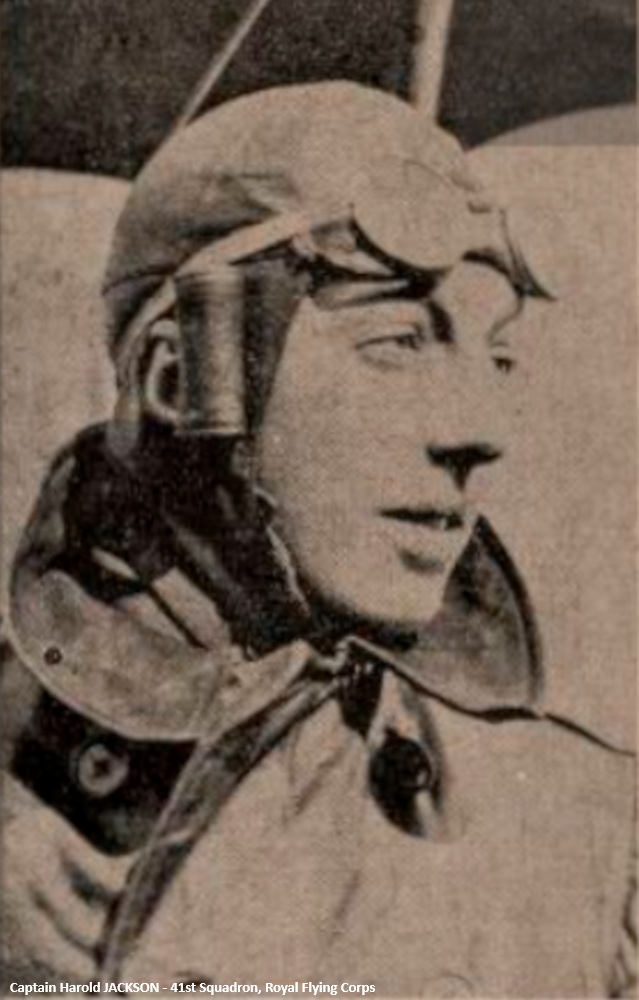
Harold is listed as being killed in action on 7th June 1917. Harold took off from Abeele Airfield on an offensive patrol in his obsolete (they were replaced a month later) Royal Aircraft Factory F.E.8 serial #6437 of 41 Sqdn. On the way to his target he was hit by an artillery shell, he was able to fly the aircraft but in attempting a crash landing he hit a tree. He was injured and died later the same day at a nearby dressing station. The Coventry Evening reported the following on 12th June 1916: Death in action in France - News has been received from the War Office that Captain Harold Jackson, Royal Flying Corps, the youngest son of Mr F T Jackson of “The Spring”, Stoke was killed in action on June 7. The deceased officer was only twenty one years of age and during his service with the army had accomplished much valuable work and gained rapid promotion. At the outbreak of the war he joined the Flying School at Hendon and underwent instruction, having eventually gazetted to the 13th Royal Warwickshire Regiment and afterwards transferred to the Royal Flying Corps. He had been in France just under eight months when he met his death and during that period he took a prominent part in the British offensive and worthily upheld the tradition of this branch of the service. Captain Jackson received his captaincy on May 17 last and was expected home on leave in a few days time. Much sympathy will be felt with the family in their bereavement”. The following day (13th) The Coventry Evening reported: “ The Late Capt. H Jackson R.F.C. - His commanding officer’s tribute - A gallant death of a gallant man - Mr F T Jackson of “The Spring”, Stoke has received the following letter of sympathy from the commanding officer of the RFC Squadron with reference to the heroic death of Captain Harold Jackson already announced in our columns.
“Dear Mr Jackson you have no doubt already heard from the War Office that your gallant son has met a very heroic end. I must try and tell you how very deeply we, all the Squadron, sympathise with you and all his relations. I will try and tell you all the facts as far as i know them. I am sure besides your grief you will feel the very greatest pride. He died in the most gallant manner possible and although we all here mourned a brave and true friend and brother officer, we all feel the greatest pride that such a great and gallant man belonged to this Squadron.
He was out on patrol on the day of the great attack, which you have all read of. The weather became very bad and he evidently went down quite low to engage the infantry and transport on the road quite a long way over the lines. Whilst doing this he was hit by a shell and wounded seriously. He brought his machine the whole way back over the lines apparently quite under control. He was obviously trying to find a landing ground but there was no suitable place and on landing the machine hit a tree, otherwise I think he would have landed it safely.
He asked for an officer and a colonel who was running to the machine spoke spoke to him and gave him his morphia. This colonel I saw myself afterwards and he spoke to me also. He said your son was absolutely wonderful. perfectly calm and collected and not complaining. He was at once taken to the dressing station where he died quite peacefully and without any pain about three-quarters of an hour later. He was as brave as ever at the end and the impression made on the infantry and clergyman and doctor who were with him was immense Unfortunately, as the battle was still on, the Hospital authorities were unable to let us know anything until the next day and so we only knew that he was missing. I went down last night with two of my officers and we put a cross on the grave. I am sure your son could not have wished a more heroic death All his deeds were great ones. He has done the most splendid things out here and I cannot tell you how we all admired and liked him. Everyone in the Squadron has lost a real and great friend".
|
| Personal & Family History |
| Birth Date/Place | Baptism Date/Place |
|---|---|
| 15 Jun 1895 in Coventry | 22 Jul 1885 Holy Trinity Church, Coventry |
| Parents Names | Abode |
| Frederick Thomas and Lottie Jackson | The Spring, Stoke, Coventry |
| Schools | Schools |
| Warwick (King's) School | Solihull Grammar School 1908-1911 |
| Address History | Employment History |
| 1895 - 3 Jesson Street, Coventry | 1901 - School age |
| 1901 - Stoke Green, Coventry | 1911 - Pupil at Solihull School |
| 1911 - Solihull School, Warwick Road, Solihull | 1914 - Engineer at Coventry Radiator Co (family owned) |
| 1915 - The Spring, Stoke, Coventry | |