South Warwickshire Family History Society War Memorial Transcription Project
The Fallen Men of South Warwickshire - World War One |
|
|

|
Military History |
| Theatre of War | Medals | Commonwealth War Grave or Memorial |
|---|---|---|
| France & Flanders | 1914-15 Star, British War & Victory Medals | Loos Memorial |
| Arrived in Theatre | Medal Citation (if app) | SWFHS Area Memorials |
| 8 June 1915 in France | ~ | Knowle Soldiers Chapel |
| Knowle War Memorial | ||
| Action, Battle or Other Reason Killed | Date and Place Enlisted | |
| Battle of Loos | 2 September 1914 in Walsall | Other War Memorials |
| Solihull War Memorial | ||
| Place of Death | Previous Regiments or Units | |
| near Vermelles | 13th Hussars | |
Circumstances of Death
|
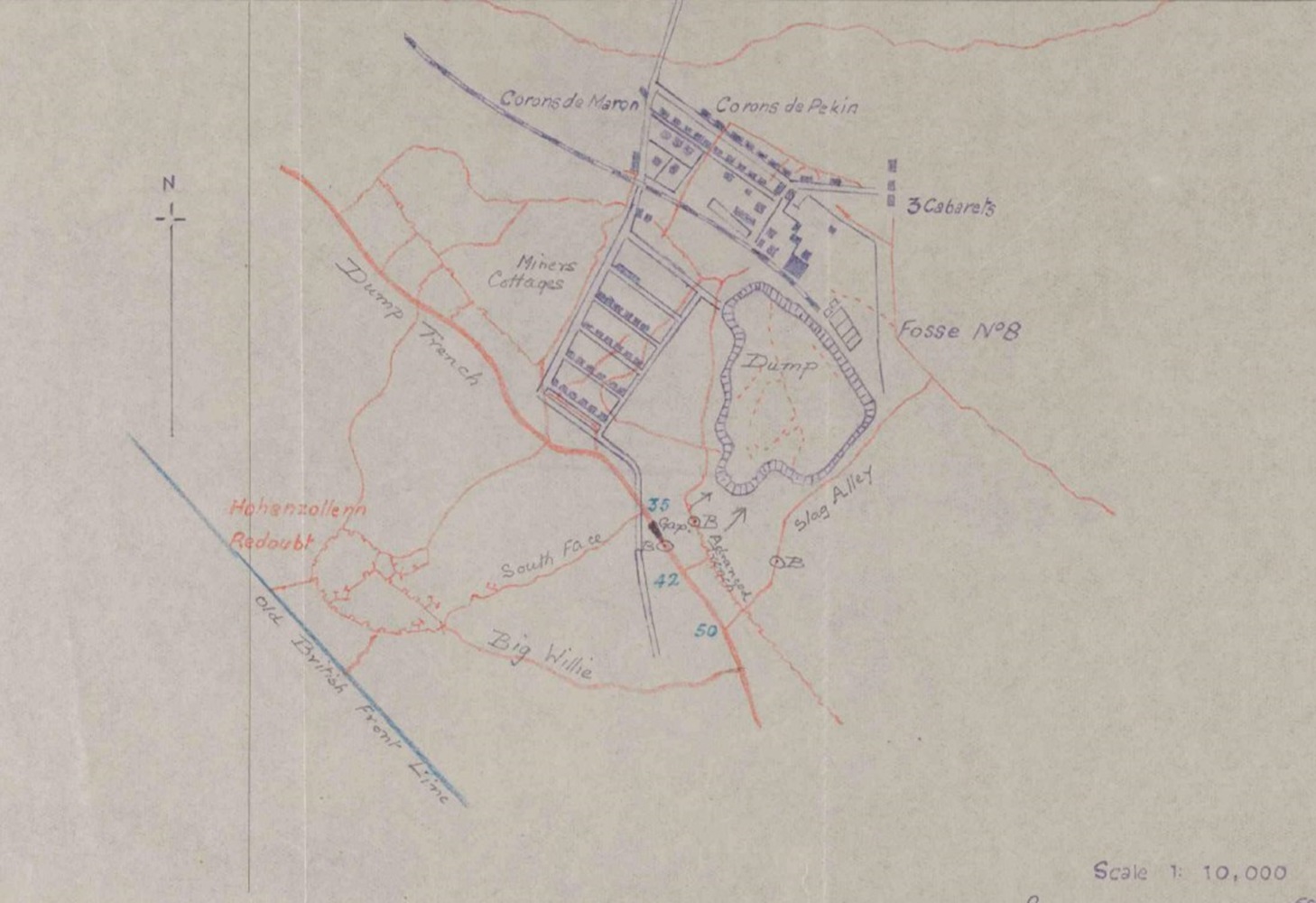
George is listed as being killed in action on 28th September 1915 during the Battle of Loos. The following description of the events for the 27th to 29th come courtesty of MIchael, a user on the Great War Forum. Forming Up for the AttackThe following description of the part the battalion played in the struggle would be somewhat difficult to follow without the accompanying sketch of the ground about the Hohenzollern Redoubt and the Dump.
At 2 o'clock A and D Companies, under Major M Beevor, were ordered to relieve certain parties just north of Fosse 8, the situation at which point, it may be remembered, was described by the Commander-in-Chief as being distinctly precarious. Finding that the position in question had been abandoned, these companies were ordered by their Brigadier, who accompanied them, to establish themselves in the Hohenzollern Redoubt. Finding that the normal approach to this, that is, the communication trench, was too congested with troops to use, the Buffs quitted it and reached their appointed place across country, being very heavily shelled en route. In fact, both Br.-General Pereira and his brigade major, Captain Flower, were wounded, as was Lieut. Cory-Wright, who commanded D Company. On arrival, a platoon of this company charged the enemy vigorously and accounted for a score. The companies remained in situation all night, during which our bombers had to be very active, while the wounded—and there were very many of different units —were being removed, a matter of great difficulty on account of heavy rain and the distance they had to be carried. During this night the rest of the 85th Brigade came up and B and C Companies took up a position behind A and D. After a contradictory order or two, an assault on the dump of Fosse 8 was arranged for 9.30 a.m. on the 28th, to be preceded by fifteen minutes artillery fire. The Buffs began at the hour named to file up the trenches, A Company leading, with D just behind. The congested state of these avenues, due to dead, wounded and troops waiting to be relieved, rendered progress very slow, and many casualties were suffered from shell fire. The place from which one of the companies was to start the attack was still in the hands of the enemy, and all these circumstances prevented the men from getting into their approximate positions till after 10 a.m. The Middlesex Regiment was in support of the Buffs. The AttackWhen the time came B and C Companies, followed by A, charged across the open and were greeted with the fire from machine guns massed on either flank, also shell and rifle fire. At least eleven machine guns were afterwards counted firing from the Miners' Cottages and Slag Alley. B and C Companies, every man cheering, gained the edge of the Dump and, clambering up the crumbling slopes of that 30-foot-high mound, gained the summit. On the way Captain W. R. Davis (commanding B Company) was killed and Lieut. S. C Swayne and 2nd Lieut. M. Selby mortally wounded. V? Lieut. H. Mantle, 2nd Lieuts. C. H. B. Budd, G. E. Boon, Captain M. M. Brice (commanding C Company) and 2nd Lieut. G. E. A. Steggall were all wounded and the latter taken prisoner. The Dump was then plastered with shells of all descriptions both from our own guns and those of the enemy and the attack was broken. The companies crossed the large expanse of the Dump summit and 100 attempted to reach the enemy in the trenches at the foot. It was a hopeless task, and those who attempted it were shot or grenaded. The companies re-formed and returned to the original trenches, leaving over one hundred men killed or wounded on the Dump. The guns ceased fire and the bomb fighting commenced. Making use of all their trenches leading into their old lines, the Germans advanced swiftly under cover of showers of bombs and their machine guns. The enemy effected a gap (see sketch) between the Middlesex and Buffs and from it bombed both ways. Thus the Buffs found themselves to the south-east of the point where the enemy had penetrated and separated from their supporting battalion, the Middlesex, who were to the north-west of the gap. Here the struggle was fought out for a long period chiefly by the use of bombs, which were obtained with difficulty, having to be passed up the shallow trench from troops in rear. Barricades had to be built at certain points to keep the enemy in check. Slag Alley was almost in complete possession of the Germans when A Company, charging repeatedly and with the greatest vigour, drove them back and accounted for about fifty. At this time 2nd Lieut. F. A. Booth was shot dead while accepting the surrender of a German officer. The enemy's supply of bombs was so superior to our own that the whole of A Company's gains could not be retained, but the men built a barricade across Slag Alley to secure the portion they could hold. The fiercest fighting now took place at the gap in Dump trench. 2nd Lieut. W. T. Williams took charge of the bombers at this point and for 17 hours kept the enemy in check. The greatest difficulty was experienced in obtaining a sufficient supply of bombs. The enemy's machine guns and snipers were particularly active and the advanced trenches were very shallow. Lt.-Colonel C. A. Worthington commanding the battalion, and 2nd Lieut. T. Penington were killed by the same bullet. The command devolved on the adjutant, Captain J. V. R. Jackson, in the absence of Major M. Beevor. The latter officer had been ordered to remain at Point 35 until the two rear companies of the Middlesex had filed past. As, however the Germans had established themselves so strongly in the gap, Major Beevor had perforce to remain with the Middlesex. On the death of Colonel Neale of the latter regiment, he conducted operations on the other side of the gap and along South Face. As night fell the rain commenced again and never ceased. Shell and rifle fire slackened, but the bomb throwing was stronger than ever. Our bomb throwers were nearly all killed or wounded, and others were borrowed from neighbouring units. Owing to the rain, the fuses were damp, matches gave out, and the only way to light the fuses was by means of keeping cigarettes alight. The organization of the enemy as regards this weapon was astounding. He threw at least five to our one and of a much more powerful description. After the AttackDuring the night every endeavour was made to get in the wounded. Neither rations nor water were obtainable. Attempts were made to dig in, but the mud rendered it a slow and laborious task. Dawn showed no cessation in the bomb throwing. Captain Jackson had sent messages for bombs and assistance: two messengers were killed, and finally an answer came that two companies of the York and Lancs were coming in relief and the Buffs were to make their way to Big Willie. At 8.30 a.m. the relief was just entering the Dump trenches at Point 50 when the supply of bombs gave out altogether while the enemy kept up an incessant shower. The Buffs were forced back to the fork and filed down the advanced trench, whilst their relief filed in, leaped out of the trenches and held the enemy. During this critical period a little ground was lost owing to lack of bombs. Captain Jackson could not emerge from a deep dug-out near the gap from which he was conducting operations, and he was taken prisoner. The balance of the regiment made its way back by Big Willie trench to near its junction with the South Face. Here Major Beevor took command. The Middlesex was being pressed back, and there being no room between them and the 3rd Royal Fusiliers, the Buffs filed back into the old front-line British trench, where they were able to materially assist the units in front by means of rifle fire. The night was spent in reorganizing and at midnight the battalion left the trencher and marched to Annequin. Casualties. Officers, killed Lt Colonel C. A. Worthington, Captain W.R Davis 2nd Lieuts. F. A. Booth, T. Penington and N. E. Wood. Died of wounds: Lieut. S. C. Swayne and 2nd Lieut. M. Selby. Wounded: Captain M. M. Brice, Lieuts. G. Cory-Wright, H. Mantle; 2nd Lieuts. G. E. Boon, C. H. B. Budd and W. T. Williams. Taken prisoner: Captain J. V. R. Jackson and 2nd Lieut. G. E. A. Steggall (wounded). Other ranks: killed, 57; wounded, 168; missing, 133. The majority of the latter are believed to have been killed or wounded on the Dump." |
| Personal & Family History |
| Birth Date/Place | Baptism Date/Place |
|---|---|
| Jul Qtr 1891 in Packwood | |
| Parents Names | Abode |
| Daniel and Charlotte Eliza Lindon | Widney Rd., Knowle |
| Schools | Colleges |
| ~ | |
| Address History | Employment History |
| 1891 - Station Road, Packwood | 1901 - School age |
| 1901 - Wash Pill Farm, Station Road, Knowle | 1911 - Gardener at Knowle Hall |
| 1911 - The Lodge, Knowle Hall, Knowle | 1914 - Gardener |
| 1914 - Widney Road, Knowle | |
- Choirboy at Knowle Parish Church
Back to Index